Originally published on yuvalyeret.com.AI is forcing everybody to be very agile about who they are, what they do, what impact can they make, and how they're perceived, including myself. I've pivoted from Scaling with Agility to Scaling AI from Activity to Impact.
Originally published on yuvalyeret.com.AI is forcing everybody to be very agile about who they are, what they do, what impact can they make, and how they're perceived, including myself. I've pivoted from Scaling with Agility to Scaling AI from Activity to Impact.
Am I just jumping on the AI bandwagon?I've worked on AI-adjacent scaling and agility challenges quite a bit over the last couple of years and that's shifting into AI adoption in product/engineering organizations and the wider business more recently. I've noticed that there's a lot in common.
Many of the patterns that I developed, used, and avoided for improving development lifecycles and how companies work over the years are very applicable when trying to shift organizations from AI ambition to AI-Native operating systems. For example, AI theater caught up very quickly to something that took a decade in the agile world to happen. AI is much faster about everything.
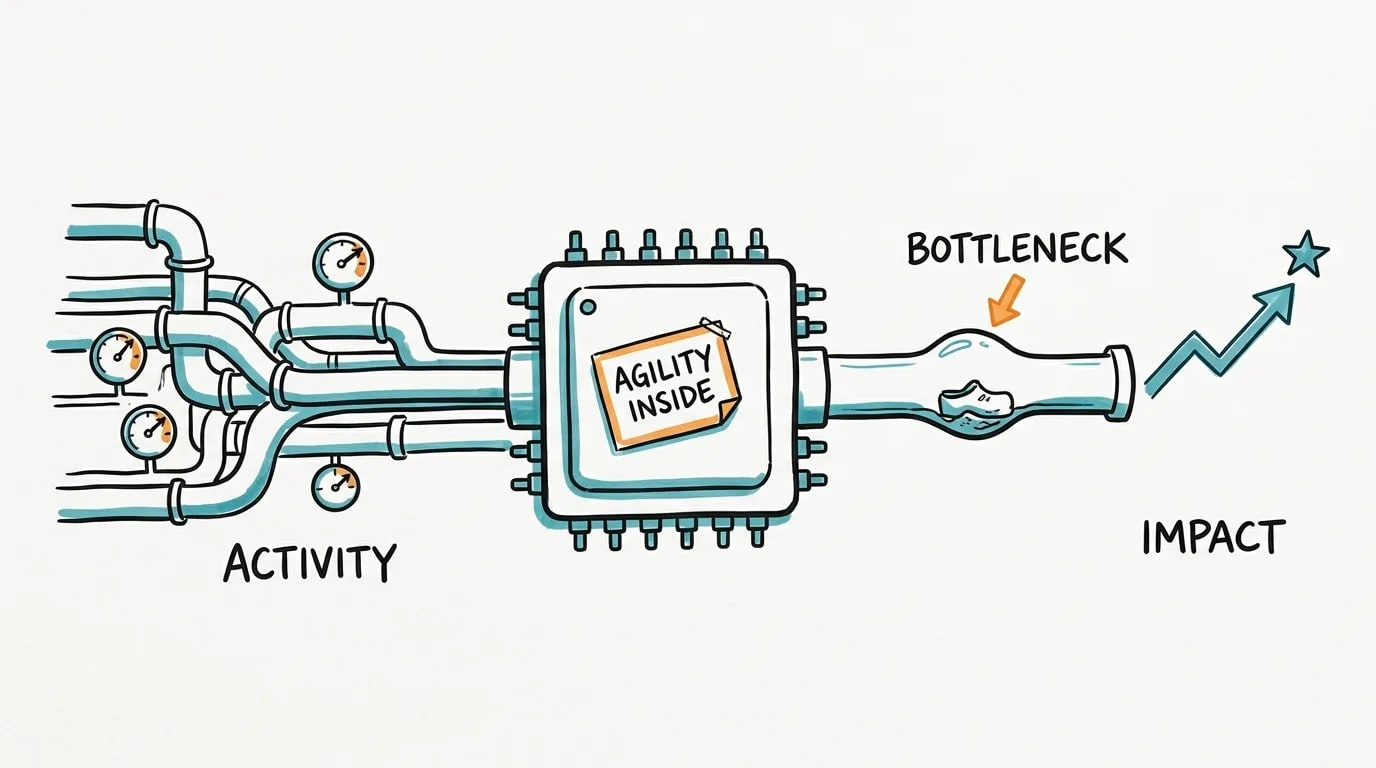
All the way from network / operating-system plumbing to AI-Native plumbingI often say that I'm a plumber. Not because that's maybe the profitable future for us knowledge workers when AGI is here, but no. I found myself over the years, whether it was in the Israeli Air Force back in the nineties, or leading engineering teams and building engineering systems, or over the last almost twenty years at this point helping leaders improve flow in their engineering pipelines and eventually outside of engineering in marketing, sales, throughout the organization. It's like plumbing. Sometimes things are stuck, sometimes there's a bottleneck, sometimes there's a very ugly mess on the floor that you need to clean up. Whatever the context, I come and help organizations, and I do that much better than I do real plumbing.
In context
- Topic: Proyectos, PMO y Riesgos — Gestión de proyectos, oficinas de proyecto y riesgo del portafolio.
- Source: Scrum.org
- Published: 27/08/2026
Continue reading at the original source →
Excerpt published automatically by the site radar. The full text belongs to its publisher and is linked above.
Why it matters
In project management, nearly everything discussed as a technical problem is really a problem of expectations badly negotiated at the start. Scope, time and cost were agreed at a moment when nobody had enough information, and afterwards nobody wanted to reopen the conversation.
I read these things looking for where the risk sat before it became an incident. It was almost always already written in some register nobody reviewed, with an assigned owner who never found out they were one. A risk identified and not managed is worse than one never identified: it creates the false sense that there is control.
What usually goes wrong
The classic mistake is treating risk management as a deliverable of the planning phase. The matrix gets built, approved, filed. Nobody opens it again until closure, when it serves to document that the risk was foreseen — which is exactly the opposite of managing it.
What to watch
- The size of the first useful delivery: the further out it is, the more it resembles a bet.
- How it was estimated and how close the same organisation's previous estimates turned out to be.
- Who the sponsor is and how often they actually show up — not on the org chart, in the calendar.
How I read this entry
I would use it to review how the organisation estimates. If historical estimates were systematically out by half and nobody adjusted the method, no project will land well: you are planning with a ruler that measures short and blaming the team for not reaching the mark.
This entry is an excerpt from the original source, selected by the site radar. The commentary above is the site's own and does not belong to the cited publisher.
Living through this in your own team?
Open the chat and tell me how you're handling it. I'm interested in comparing notes.