The reinforcement learning (RL) ecosystem is rapidly adopting Ray as the unified compute runtime for complex post-training workflows. Across Google Cloud, we see customers using Ray for workloads ranging from multimodal data pipelines to frontier RL.
The reinforcement learning (RL) ecosystem is rapidly adopting Ray as the unified compute runtime for complex post-training workflows. Across Google Cloud, we see customers using Ray for workloads ranging from multimodal data pipelines to frontier RL.
Sandboxes as Ray Primitives Ray has become a common runtime for orchestrating post-training workloads. Frameworks including veRL, NeMo-RL, SLIME, MILES, and SkyRL already use Ray to coordinate distributed trainers, inference engines, rollout workers, and other components.
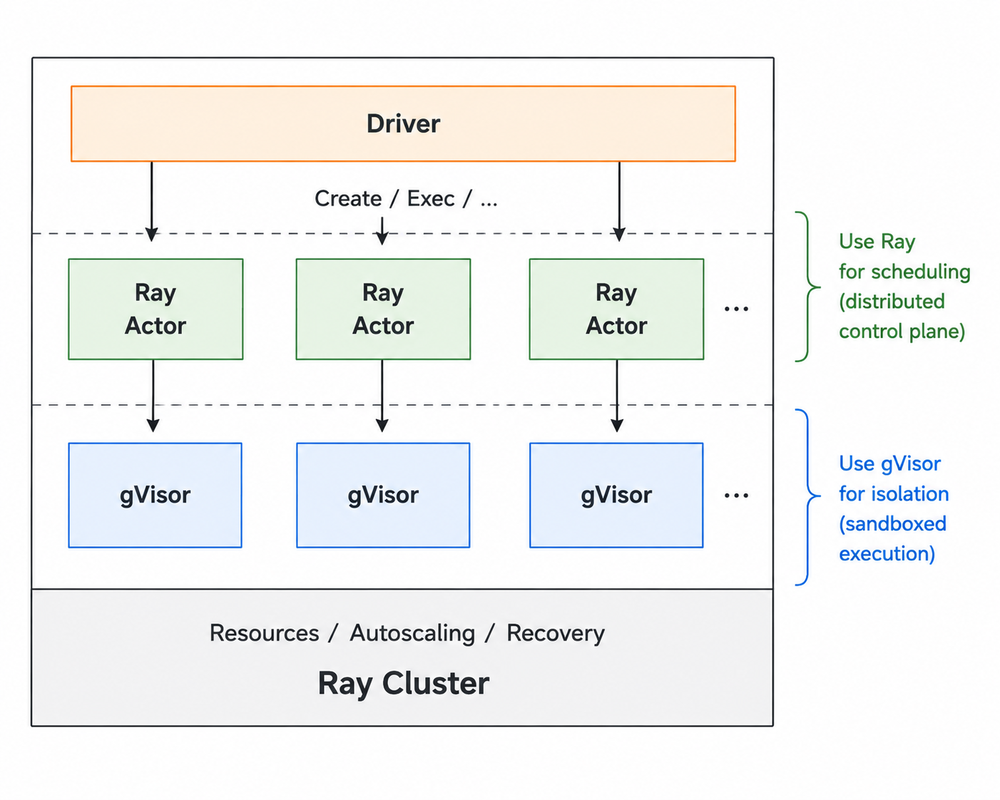
When we designed Ray Sandboxing, an important goal was to make it fit naturally into the existing Ray programming model rather than introduce a separate abstraction for isolated execution. A sandbox has many of the same properties as other resources managed by Ray: it needs to be placed on a machine, assigned resources, created and destroyed, recovered from failures, and scaled with the surrounding workload. This led us to represent each high-level sandbox through a Ray Actor:
The Ray scheduler decides which node should run a sandbox and reserves the corresponding CPU and memory resources. The sandbox Actor manages its lifecycle, while gVisor provides the isolated execution environment on that node.
Starting in Ray 2.58, framework authors and researchers can manage sandboxed environments using the same Ray APIs and patterns they already use for the rest of their workload. For example:
code_block <ListValue: [StructValue([('code', 'import ray\r\nfrom ray.experimental import sandbox\r\n\r\nray.init()\r\n# Create a gVisor sandbox environment and return an actor handle for a proxy actor\r\nsb = sandbox.create(\r\n cpu=1.0,\r\n memory="512Mi",\r\n image="python:3.12-slim"\r\n)\r\n# Execute code inside the sandbox\r\nresult = ray.get(sb.exec.remote("python -c \'import sys; print(sys.version)\'"))\r\nprint(result.stdout)'), ('language', ''), ('caption', <wagtail.rich_text.RichText object at 0x7f8f2ea7f610>)])]>
In context
- Topic: Cloud y Arquitectura — Nube pública, híbrida, costos y decisiones de infraestructura.
- Source: Google Cloud Blog
- Published: 25/08/2026
Continue reading at the original source →
Excerpt published automatically by the site radar. The full text belongs to its publisher and is linked above.
Why it matters
The cloud conversation moved from migrate everything to deciding what goes where. That maturity is a good sign, but it also makes the discussion harder: there is no single answer any more, it has to be argued case by case, and very few people have the numbers to do it.
What I look at in these announcements is portability. The more comfortable a platform is, the harder it usually is to leave, and that comfort gets paid for in negotiating power three years later, exactly when renewal comes up and there is no credible alternative left.
What usually goes wrong
Where it usually breaks is team capability. The platform is new but people learned on the fly, with no time and no support. They end up replicating data-centre practices in the cloud, which means paying cloud prices for benefits that never arrive.
What to watch
- Who sees the bill and in what detail: with no owner for the spend, the spend grows on its own.
- Where the data physically sits and what local regulation demands about that.
- What happens when the provider has an outage, because it will, and what keeps running meanwhile.
How I read this entry
I would read it thinking about the exit before the entry. Not because anyone plans to leave, but because the conversation about how you would leave is the one that reveals how much you are locking in. If nobody at the table can describe that path, the dependency is already deeper than they think.
This entry is an excerpt from the original source, selected by the site radar. The commentary above is the site's own and does not belong to the cited publisher.
Living through this in your own team?
Open the chat and tell me how you're handling it. I'm interested in comparing notes.