Critical Asked Questions (CAQ) About PSM-AI Essentials Course
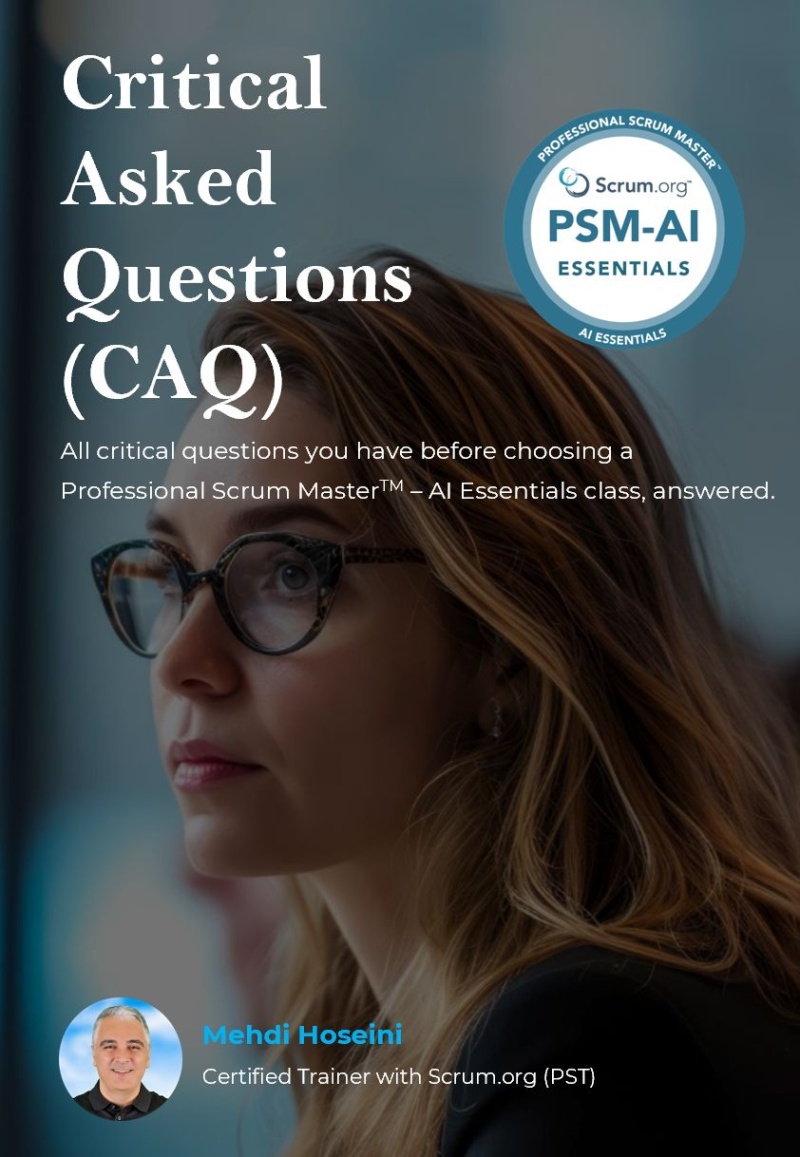
In this blog post, I answer critical questions you have before choosing a Professional Scrum Master – AI Essentials class. Image 1- Why should I take the class when I can directly take the PSM-AI Essentials exam and get the certificate without attending the class?Yes, you can skip the class and just take the exam.
In this blog post, I answer critical questions you have before choosing a Professional Scrum Master – AI Essentials class. Image 1- Why should I take the class when I can directly take the PSM-AI Essentials exam and get the certificate without attending the class?Yes, you can skip the class and just take the exam.
When your people ask you how AI should reshape your team's Scrum way of working, nobody will ask to see your badge. They will watch how you show up in the room and how you lead your Scrum Team in their AI journey.
These are the consequences of getting the certificate without attending the class:
You just learn the theory under your own supervision. (Not the practical aspect, and with no trainer supervision)
You are not sure if you have learned all the pieces of the puzzle that you should learn. A lot of blind spots can be left.
You miss the opportunity to get your hands dirty through practical exercises in class.
In context
- Topic: Proyectos, PMO y Riesgos — Gestión de proyectos, oficinas de proyecto y riesgo del portafolio.
- Source: Scrum.org
- Published: 19/08/2026
Continue reading at the original source →
Excerpt published automatically by the site radar. The full text belongs to its publisher and is linked above.
Why it matters
A project management office is worth the decisions it makes possible, not the reports it produces. Once the PMO becomes the function chasing status updates, it has already lost: the team learns to fill in the template and the real information goes back to travelling through the corridors.
My filter is the quality of the status report. If every project is green, the reporting system is not working: in any real portfolio some initiatives are in trouble, and a healthy organisation surfaces them in time rather than discovering them at the closure committee.
What usually goes wrong
The classic mistake is treating risk management as a deliverable of the planning phase. The matrix gets built, approved, filed. Nobody opens it again until closure, when it serves to document that the risk was foreseen — which is exactly the opposite of managing it.
What to watch
- Which risks are identified, who owns each one, and when they were last reviewed.
- The size of the first useful delivery: the further out it is, the more it resembles a bet.
- How it was estimated and how close the same organisation's previous estimates turned out to be.
How I read this entry
I would use it to review how the organisation estimates. If historical estimates were systematically out by half and nobody adjusted the method, no project will land well: you are planning with a ruler that measures short and blaming the team for not reaching the mark.
This entry is an excerpt from the original source, selected by the site radar. The commentary above is the site's own and does not belong to the cited publisher.
Living through this in your own team?
Open the chat and tell me how you're handling it. I'm interested in comparing notes.