
Microsoft Moves AI Governance from Policy to Runtime Enforcement
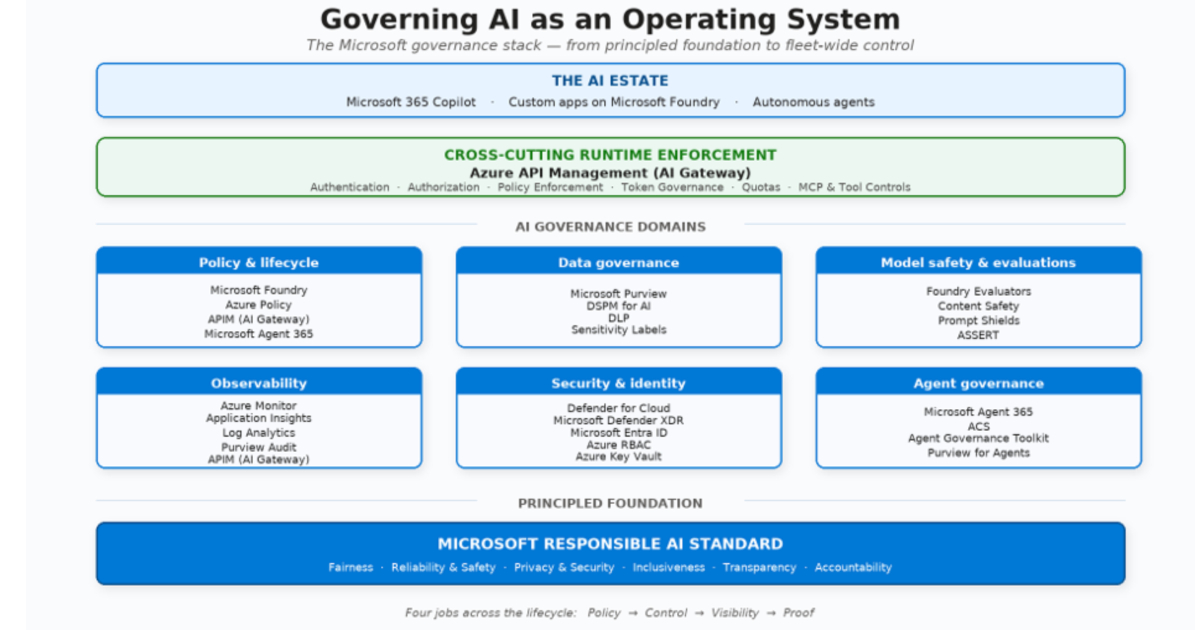
Microsoft has outlined an AI governance architecture spanning nine governance domains and four functions: policy, control, visibility, and proof. The approach connects policies with runtime enforcement, continuous evaluation, observability, identity, security, and audit evidence to help organizations verify governance…
Microsoft has outlined an AI governance architecture spanning nine governance domains and four functions: policy, control, visibility, and proof. The approach connects policies with runtime enforcement, continuous evaluation, observability, identity, security, and audit evidence to help organizations verify governance…
In context
- Topic: Estrategia y Gobierno de TI — Decisiones de portafolio, costo total, gobierno y marcos de referencia.
- Source: InfoQ
- Published: 24/08/2026
Continue reading at the original source →
Excerpt published automatically by the site radar. The full text belongs to its publisher and is linked above.
Why it matters
When an organisation announces a turn like this, the announcement is rarely the interesting part. What matters is everything it forces to be reordered underneath: committed budgets, live contracts, teams built for something else. That is where you find out whether the decision had real backing or was a slide in a deck.
I read it looking for coordination cost. Every technology decision splits work across areas that do not report to each other, and that is where the return leaks out. If nobody defined who resolves it when two areas disagree, the project already has its grounding date set.
What usually goes wrong
What usually goes wrong is the part never discussed with the areas that will carry the work. It gets decided at the top, communicated downward, and the resistance shows up not as opposition but as slowness. Nobody says no; everything simply takes twice as long and nobody can explain why.
What to watch
- The real calendar of contracts and renewals: that is where you see whether the move was strategic or was an expiry date.
- What gets switched off to fund the new thing; if nothing does, the budget will hurt in six months.
- How the relationship with current vendors is left, which is usually where the dependency nobody measured is sitting.
How I read this entry
The way I would bring this down to earth is in three moves: name an owner with their own budget, define two metrics reviewed in committee every month, and set a date on which somebody decides to continue or stop. It is unglamorous, and it is what separates programmes that land from programmes that get discussed.
This entry is an excerpt from the original source, selected by the site radar. The commentary above is the site's own and does not belong to the cited publisher.
Living through this in your own team?
Open the chat and tell me how you're handling it. I'm interested in comparing notes.