
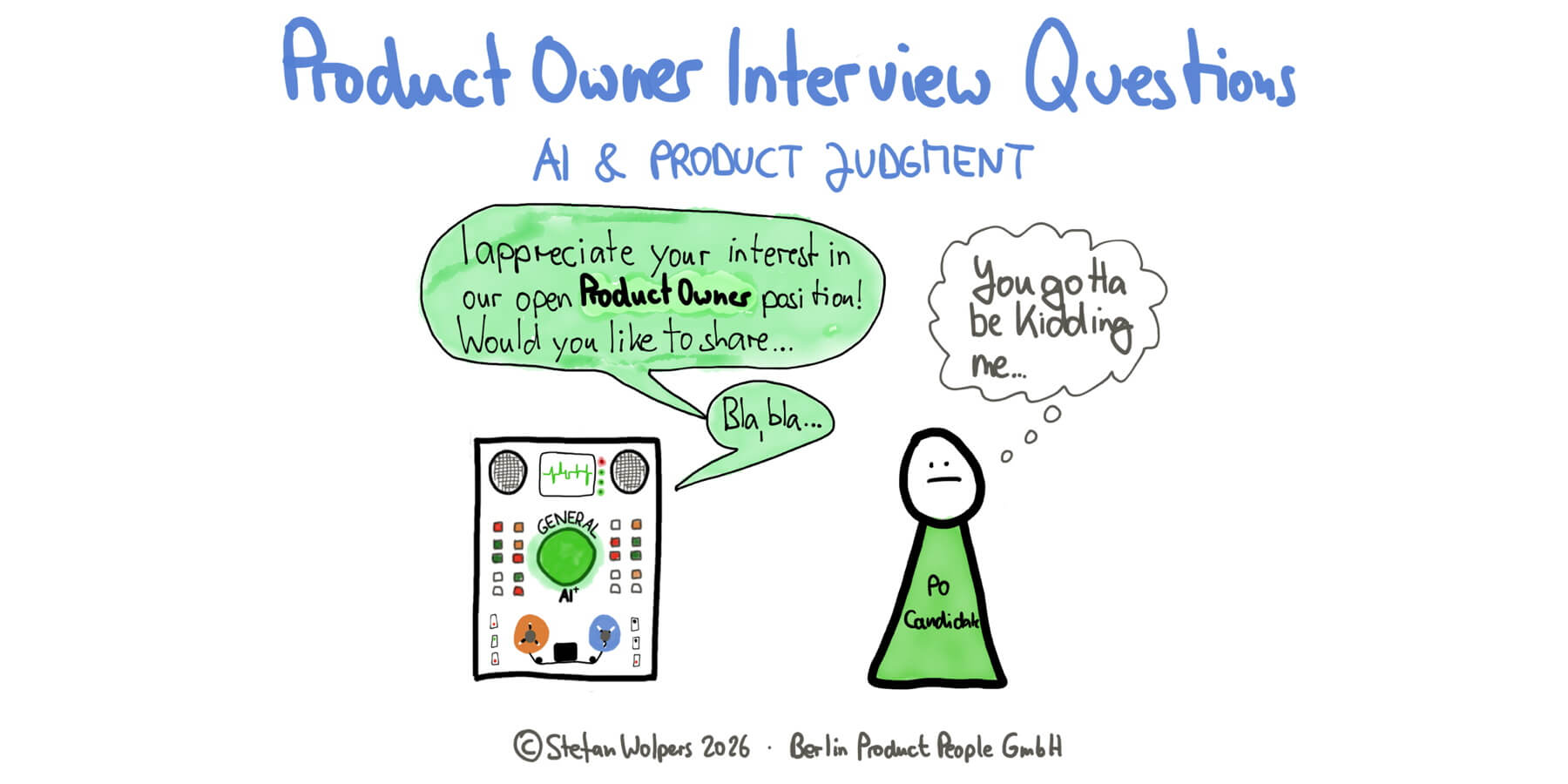
TL; DR: 10 New Product Owner Interview Questions on AI“How do you use AI in your work?” If that is still one of your Product Owner interview questions, you are screening for tooling fluency in a role that lives or dies on product judgment. Every candidate has an answer; LLMs make sure of that.
TL; DR: 10 New Product Owner Interview Questions on AI“How do you use AI in your work?” If that is still one of your Product Owner interview questions, you are screening for tooling fluency in a role that lives or dies on product judgment. Every candidate has an answer; LLMs make sure of that.
These ten new Product Owner interview questions are designed to expose the gap. Each one has a seductive wrong answer that sounds smart enough to pass a surface-level interview. The strong answers require something a blog post cannot teach: lived experience with the judgment calls that the Product Owner role now demands, as three shifts justify the addition: the collapse of code generation cost, the rise of product operating models that rename existing practices without rewiring, and the quiet fact that AI is already reshaping product decisions in organizations that made no deliberate decision about it.
Thesis: When building is no longer the constraint, every Product Owner interview question must test the candidate’s judgment about what is worth building, not their fluency with the tools that build it.
🗞 Shall I notify you about articles like this one? Awesome! You can sign up here for the ‘Food for Agile Thought’ newsletter and join 35,000-plus subscribers.
Set 9: The Product Owner in the Age of AI, the Product Operating Model, and Agile First Principles10 New Product Owner Interview Questions — BackgroundMost hiring managers have already added their AI question to the interview: “How do you use AI in your work?” Also, this question is likely useless, as every candidate has an answer; LLMs do a good job in preparing every applicant. Therefore, the usual answers tend to be unremarkable, and none of them tell you whether the person can decide what is worth building when building is no longer the hard part.
In context
- Topic: Proyectos, PMO y Riesgos — Gestión de proyectos, oficinas de proyecto y riesgo del portafolio.
- Source: Scrum.org
- Published: 24/08/2026
Continue reading at the original source →
Excerpt published automatically by the site radar. The full text belongs to its publisher and is linked above.
Por qué importa
Los proyectos rara vez fracasan el día que se declaran fracasados. Fracasan meses antes, en una reunión donde alguien vio venir el problema y calculó que no le convenía decirlo. Todo lo demás —el cronograma que se corre, el presupuesto que se estira— es la consecuencia visible de ese silencio.
Leo estas cosas buscando dónde estaba el riesgo antes de convertirse en incidente. Casi siempre ya estaba escrito en algún registro que nadie revisaba, con un dueño asignado que nunca se enteró de que lo era. El riesgo identificado y no gestionado es peor que el no identificado: da la falsa sensación de que hay control.
Lo que suele salir mal
El error clásico es tratar la gestión de riesgos como un entregable de la fase de planificación. Se arma la matriz, se aprueba, se archiva. Nadie la vuelve a abrir hasta el cierre, cuando sirve para documentar que el riesgo estaba previsto — que es exactamente lo contrario de gestionarlo.
Qué mirar
- Quién es el patrocinador y con qué frecuencia real aparece — no en el organigrama, en la agenda.
- Si el reporte de estado muestra proyectos en rojo: un portafolio todo en verde es un portafolio sin información.
- Qué riesgos están identificados, quién es dueño de cada uno y cuándo se revisaron por última vez.
Cómo leo esta entrada
Yo lo usaría para revisar cómo se estima en la organización. Si las estimaciones históricas se pasaron sistemáticamente por la mitad y nadie ajustó el método, no hay proyecto que salga bien: se está planificando con un metro que mide corto y culpando al equipo por no llegar.
La noticia original está publicada en otro idioma; acá se cita el extracto tal como lo entrega el medio y el comentario se escribe en español.
¿Lo estás viviendo en tu equipo?
Abrí el chat y contame cómo lo están manejando. Me interesa comparar notas.