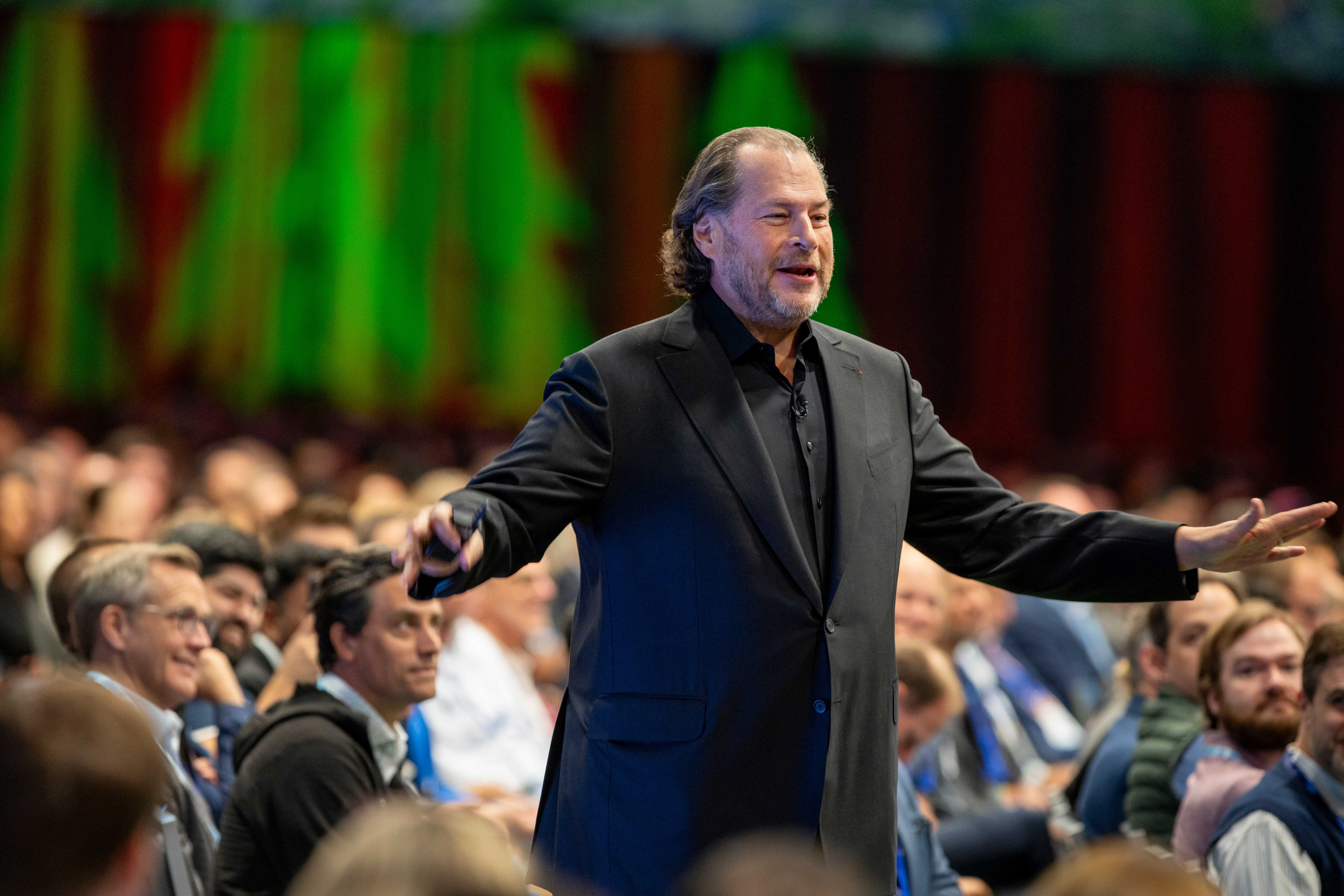
Salesforce and Anthropic today announced they have expanded their strategic partnership to deliver Claudeforce, enabling customers of both companies to leverage Salesforce data, workflows, business logic, actions, and governance within Claude.
Salesforce and Anthropic today announced they have expanded their strategic partnership to deliver Claudeforce, enabling customers of both companies to leverage Salesforce data, workflows, business logic, actions, and governance within Claude.
“What we’re seeing is that when people stop using Salesforce through the traditional human interface and start using it through an agentic interface, it dramatically increases the value of Salesforce,” Patrick Stokes, president of Applications & Marketing at Salesforce, told CIO.com on Wednesday. “They’re using Salesforce more than they ever have before.”
Stokes explained that momentum around the Claudeforce partnership began building after Salesforce’s TDX 2026 developer conference earlier this year. At the conference, Salesforce announced Headless 360, a platform that packaged Salesforce’s AI and developer tools into a headless, API-driven layer designed to help enterprise teams build agent-first workflows. It allowed AI clients like Claude or ChatGPT to read, write, and reason over Salesforce data without the traditional browser-based UI.
“It was a very popular decision among developers,” Stokes said. “Salesforce was actively endorsing people using Salesforce through an agentic interface rather than through the UI that we have had in place for 27 years.”
Developers immediately started hooking MCP servers up to their own agents. And Salesforce watched them struggle to scale their efforts.
“How do you do it for 100 or 1,000 users?” Stokes asked. “How do you deal with managed authentication to make sure it’s using the permissions of the user inside Salesforce? All the things that are necessary in order to scale this out weren’t really in place.”
In context
- Topic: Inteligencia Artificial — IA aplicada al negocio: casos, límites, costos y gobierno.
- Source: CIO
- Published: 26/08/2026
Continue reading at the original source →
Excerpt published automatically by the site radar. The full text belongs to its publisher and is linked above.
Why it matters
The conversation about artificial intelligence has become noisy, and that makes it harder to see what matters. What matters is rarely the model. It is which concrete process ends up cheaper, faster or more reliable, and who is accountable when the answer comes out wrong.
I measure AI maturity with an uncomfortable question: can anyone explain, in one line, what decision the model makes and who answers if it gets it wrong? Where that is clear, the project moves. Where it is not, it stays in permanent pilot and gets cancelled with the excuse that the technology was not ready.
What usually goes wrong
What I see fail most is the expectation. Somebody saw a flawless demo and asked for the same thing in their area within a month, without considering the demo ran on clean data prepared for the occasion. When the real pilot shows uneven results, the unfair conclusion is that the technology does not work.
What to watch
- Which concrete process is touched and how it is measured before and after; with no baseline there is no result, only opinion.
- Who reviews the model outputs and how often — the point at which AI becomes auditable.
- Cost per query at real volume, not pilot volume: the variable that produces the most surprises.
How I read this entry
My practical advice is to fix on day one what happens when the model is wrong: who reviews, how often, and at what point it gets switched off. It sounds defensive, but it is exactly what lets you be aggressive later, because the risk stopped being an unknown.
This entry is an excerpt from the original source, selected by the site radar. The commentary above is the site's own and does not belong to the cited publisher.
Living through this in your own team?
Open the chat and tell me how you're handling it. I'm interested in comparing notes.