Serverless Apache Spark on Google Cloud: Architecture Choices & AI Troubleshooting
In modern enterprise data engineering, Apache Spark remains a cornerstone framework for processing massive datasets at scale. However, managing infrastructure such as provisioning clusters, tuning YARN configurations, and avoiding costs for idle hardware often detracts from what matters most: building resilient data pi…
In modern enterprise data engineering, Apache Spark remains a cornerstone framework for processing massive datasets at scale. However, managing infrastructure such as provisioning clusters, tuning YARN configurations, and avoiding costs for idle hardware often detracts from what matters most: building resilient data pi…
This technical guide walks through the architectural decision matrix for deploying Spark on Google Cloud, details resource and cost optimization techniques, and demonstrates how to apply built-in Gemini Cloud Assist to rapidly troubleshoot and resolve serverless batch pipeline failures. While there is benefit to reading these three parts in a sequence, each one can be read independently and add value to how you approach Spark development on Google Cloud.
Part 1: Choosing your Apache Spark deployment model When launching Spark workloads on Managed Service for Apache Spark, the first major decision point is evaluating whether to construct traditional managed clusters or transition to a zero-management, serverless infrastructure footprint.
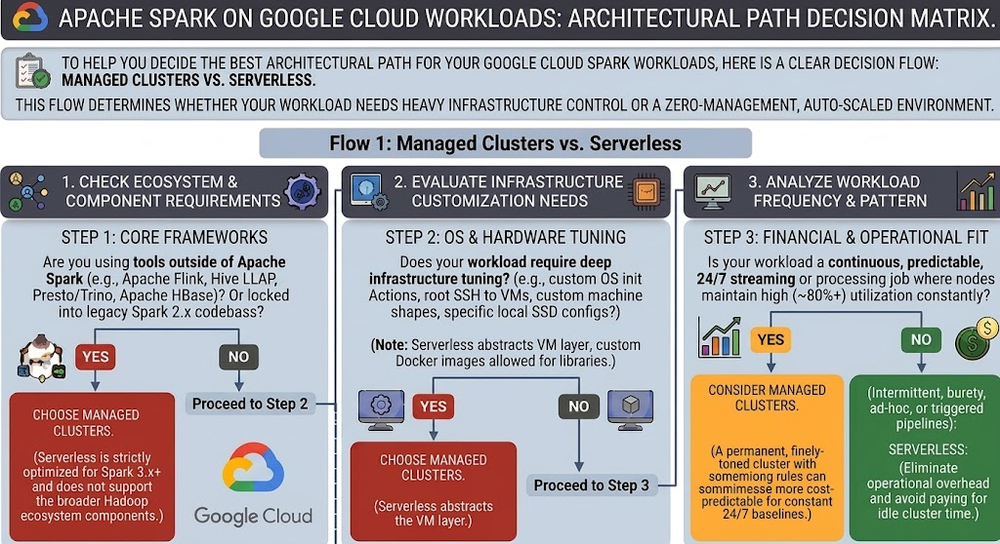
*Created using Nano Banana 2 in Gemini Enterprise Agent Platform
Choosing between traditional Managed Spark clusters and serverless depends on ecosystem requirements, infrastructure control needs, and financial utilization patterns:
Workload frequency, latency sensitive workloads & financial fit: For continuous, highly predictable, 24/7 streaming or batch processing pipelines where cluster nodes maintain constant high utilization baselines (80%+) or when the workflow’s accumulated startup time risk meeting SLA target, a permanently running, finely tuned traditional cluster, with custom YARN autoscaling rules, can sometimes be more cost-predictable. Conversely, for intermittent, bursty, ad-hoc, or orchestrator-triggered pipelines, Managed Spark serverless is highly optimal, eliminating operational management, requiring less planning time and ensuring you don’t pay for idle compute time.
In context
- Topic: Cloud y Arquitectura — Nube pública, híbrida, costos y decisiones de infraestructura.
- Source: Google Cloud Blog
- Published: 19/08/2026
Continue reading at the original source →
Excerpt published automatically by the site radar. The full text belongs to its publisher and is linked above.
Why it matters
The cloud conversation moved from migrate everything to deciding what goes where. That maturity is a good sign, but it also makes the discussion harder: there is no single answer any more, it has to be argued case by case, and very few people have the numbers to do it.
My reading goes through who sees the bill. In organisations where cloud cost reaches the team that generates it, spend organises itself. Where only finance sees the bill, spend grows and the discussion becomes a blind cut every year end.
What usually goes wrong
What I see fail most is the literal migration. The system gets moved exactly as it was, nothing redesigned, and you end up paying hourly for what used to be paid once. It works the same, costs more, and two years later somebody asks why it was done. Lift and shift is not modernising.
What to watch
- Three-year total cost with real growth, not the first-year promotion.
- How hard it would be to leave or move a piece to another provider, which is future negotiating power.
- Who sees the bill and in what detail: with no owner for the spend, the spend grows on its own.
How I read this entry
If this fed into an infrastructure decision, I would ask for the three-year total cost with real growth built in, not year one with the entry discount. Most cloud surprises live in year two, when the discount ends and the volume has already gone up.
This entry is an excerpt from the original source, selected by the site radar. The commentary above is the site's own and does not belong to the cited publisher.
Living through this in your own team?
Open the chat and tell me how you're handling it. I'm interested in comparing notes.