
Serverless Apache Spark on Google Cloud: Architecture Choices & AI Troubleshooting
In modern enterprise data engineering, Apache Spark remains a cornerstone framework for processing massive datasets at scale. However, managing infrastructure such as provisioning clusters, tuning YARN configurations, and avoiding costs for idle hardware often detracts from what matters most: building resilient data pi…
In modern enterprise data engineering, Apache Spark remains a cornerstone framework for processing massive datasets at scale. However, managing infrastructure such as provisioning clusters, tuning YARN configurations, and avoiding costs for idle hardware often detracts from what matters most: building resilient data pi…
This technical guide walks through the architectural decision matrix for deploying Spark on Google Cloud, details resource and cost optimization techniques, and demonstrates how to apply built-in Gemini Cloud Assist to rapidly troubleshoot and resolve serverless batch pipeline failures. While there is benefit to reading these three parts in a sequence, each one can be read independently and add value to how you approach Spark development on Google Cloud.
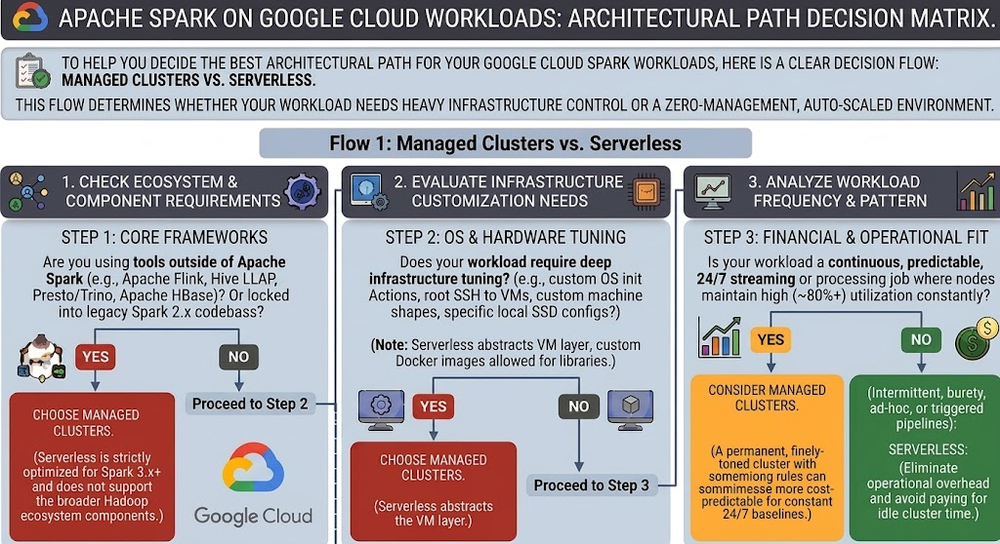
Part 1: Choosing your Apache Spark deployment model When launching Spark workloads on Managed Service for Apache Spark, the first major decision point is evaluating whether to construct traditional managed clusters or transition to a zero-management, serverless infrastructure footprint.
*Created using Nano Banana 2 in Gemini Enterprise Agent Platform
Choosing between traditional Managed Spark clusters and serverless depends on ecosystem requirements, infrastructure control needs, and financial utilization patterns:
Workload frequency, latency sensitive workloads & financial fit: For continuous, highly predictable, 24/7 streaming or batch processing pipelines where cluster nodes maintain constant high utilization baselines (80%+) or when the workflow’s accumulated startup time risk meeting SLA target, a permanently running, finely tuned traditional cluster, with custom YARN autoscaling rules, can sometimes be more cost-predictable. Conversely, for intermittent, bursty, ad-hoc, or orchestrator-triggered pipelines, Managed Spark serverless is highly optimal, eliminating operational management, requiring less planning time and ensuring you don’t pay for idle compute time.
In context
- Topic: Cloud y Arquitectura — Nube pública, híbrida, costos y decisiones de infraestructura.
- Source: Google Cloud Blog
- Published: 19/08/2026
Continue reading at the original source →
Excerpt published automatically by the site radar. The full text belongs to its publisher and is linked above.
Por qué importa
El discurso de la nube pasó de migrar todo a decidir qué va dónde. Esa madurez es buena señal, pero también hace más difícil la conversación: ya no hay una respuesta única, hay que argumentar caso por caso y muy poca gente tiene los números para hacerlo.
Mi lectura pasa por quién ve la factura. En las organizaciones donde el costo de nube le llega al equipo que lo genera, el gasto se ordena solo. Donde la factura la ve únicamente finanzas, el gasto crece y la discusión se vuelve un recorte a ciegas cada fin de año.
Lo que suele salir mal
Lo que más veo fallar es la migración literal. Se mueve el sistema tal como estaba, sin rediseñar nada, y se termina pagando por hora lo que antes se pagaba una vez. Funciona igual, cuesta más, y a los dos años alguien pregunta para qué se hizo. Levantar y mover no es modernizar.
Qué mirar
- El costo total a tres años con crecimiento real, no la promoción del primer año.
- Qué tan difícil sería salir o mover una parte a otro proveedor, que es el poder de negociación futuro.
- Quién ve la factura y con qué detalle: sin dueño del gasto, el gasto crece solo.
Cómo leo esta entrada
Si esto entrara en una decisión de infraestructura, yo pediría el costo total a tres años con el crecimiento real puesto adentro, no el del primer año con descuento de entrada. La mayoría de las sorpresas de nube están en el año dos, cuando el descuento se acaba y el volumen ya subió.
La noticia original está publicada en otro idioma; acá se cita el extracto tal como lo entrega el medio y el comentario se escribe en español.
¿Lo estás viviendo en tu equipo?
Abrí el chat y contame cómo lo están manejando. Me interesa comparar notas.