
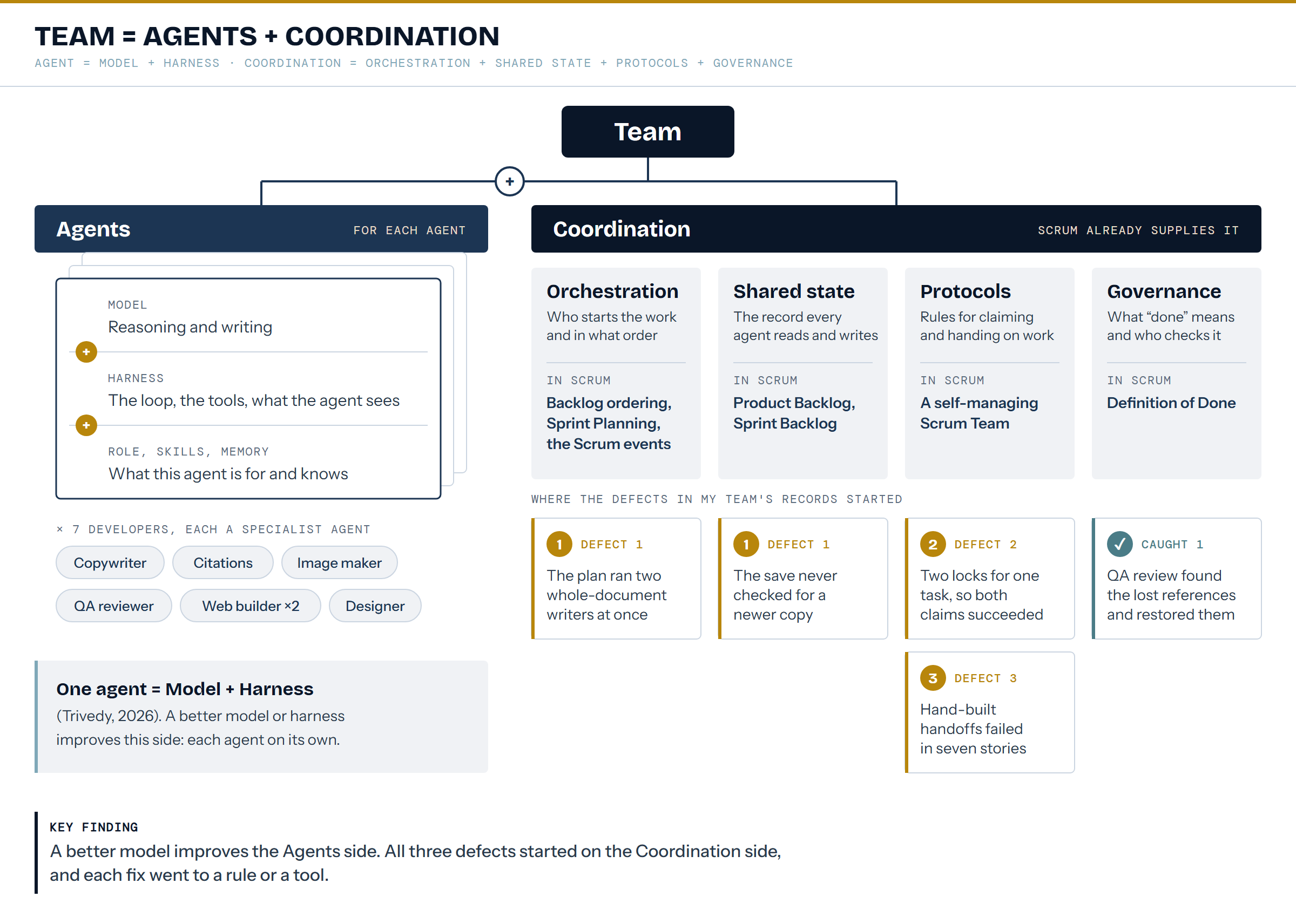
"Agent = Model + Harness" describes one AI agent well and a team of agents badly. Once agents work together, the defects that matter come from handoffs, shared records and two agents doing the same work. A better model fixes none of those. A team needs a second line: Team = Agents + Coordination.
"Agent = Model + Harness" describes one AI agent well and a team of agents badly. Once agents work together, the defects that matter come from handoffs, shared records and two agents doing the same work. A better model fixes none of those. A team needs a second line: Team = Agents + Coordination.
The formula is right for one agentVivek Trivedy of LangChain states the formula in exactly those words. He defines the harness as every piece of code, configuration and execution logic that isn't the model (Trivedy, 2026). The model supplies the reasoning and the writing. The harness is the software the agent runs in: it runs the loop, hands the agent its tools and decides what the agent sees. A better model makes one agent write better, and a better harness gets more done from the same model.
A team of agents fails at the handoffsPut several agents on one piece of work and someone has to decide which agent takes which task. Every agent also needs the same current copy of the draft. Those are decisions about how the agents work together, so they sit outside any one agent's model. Any Scrum Master has seen the human version: capable Developers who still lose work in the handoff between them.
I split coordination into four parts. The Scrum Guide covers each one (Schwaber & Sutherland, 2020):
Orchestration is who starts the work and in what order. In Scrum, the Product Owner orders the Product Backlog, the Developers plan the Sprint, and the Scrum Master makes sure the events take place, stay productive and keep to their timebox.Shared state is the record every agent reads and writes. In Scrum, that is the artifacts, such as the Product Backlog and the Sprint Backlog.Protocols are the rules for claiming work and handing it on. Scrum leaves these to the Scrum Team, which is self-managing: it decides who does what, when and how.Governance is what "done" means and who checks it. In Scrum, that is the Definition of Done. The Developers must meet it, and the Scrum Team inspects it at the Sprint Retrospective and changes it as needed.In the full model, each line expands a term from the line above:
In context
- Topic: Proyectos, PMO y Riesgos — Gestión de proyectos, oficinas de proyecto y riesgo del portafolio.
- Source: Scrum.org
- Published: 16/11/2026
Continue reading at the original source →
Excerpt published automatically by the site radar. The full text belongs to its publisher and is linked above.
Why it matters
Projects rarely fail on the day they are declared failed. They fail months earlier, in a meeting where somebody saw the problem coming and calculated it was not in their interest to say so. Everything else — the slipping schedule, the stretching budget — is the visible consequence of that silence.
I read these things looking for where the risk sat before it became an incident. It was almost always already written in some register nobody reviewed, with an assigned owner who never found out they were one. A risk identified and not managed is worse than one never identified: it creates the false sense that there is control.
What usually goes wrong
The classic mistake is treating risk management as a deliverable of the planning phase. The matrix gets built, approved, filed. Nobody opens it again until closure, when it serves to document that the risk was foreseen — which is exactly the opposite of managing it.
What to watch
- The size of the first useful delivery: the further out it is, the more it resembles a bet.
- How it was estimated and how close the same organisation's previous estimates turned out to be.
- Who the sponsor is and how often they actually show up — not on the org chart, in the calendar.
How I read this entry
I would use it to review how the organisation estimates. If historical estimates were systematically out by half and nobody adjusted the method, no project will land well: you are planning with a ruler that measures short and blaming the team for not reaching the mark.
This entry is an excerpt from the original source, selected by the site radar. The commentary above is the site's own and does not belong to the cited publisher.
Comments
No comments yet. Yours can be the first.
Living through this in your own team?
Open the chat and tell me how you're handling it. I'm interested in comparing notes.


