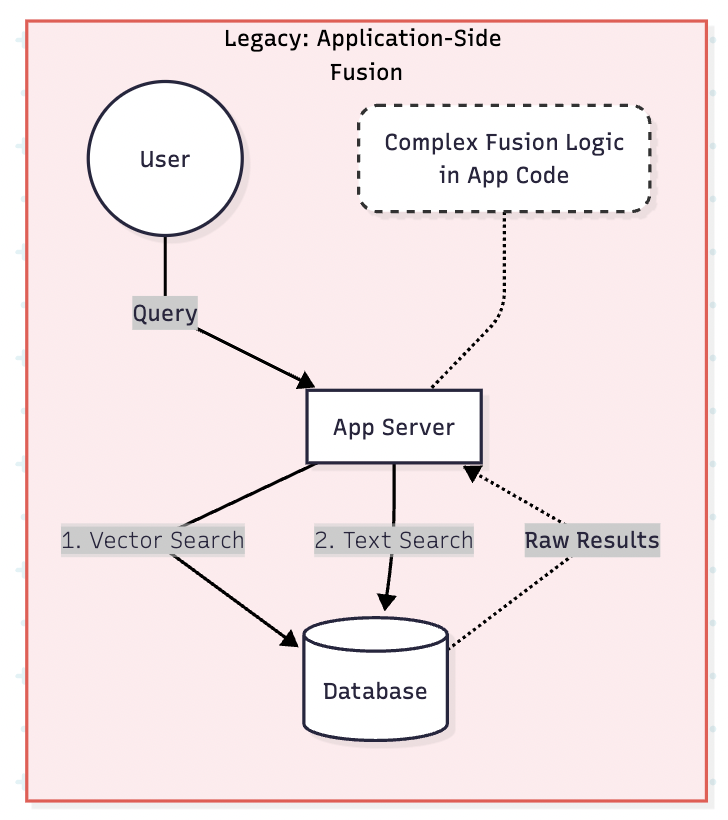
For modern AI and RAG applications, achieving high search relevance requires that you combine at least two techniques: vector search for semantic context, and full-text search (FTS) for keyword precision.
For modern AI and RAG applications, achieving high search relevance requires that you combine at least two techniques: vector search for semantic context, and full-text search (FTS) for keyword precision.
The challenge is not executing the searches, but the subsequent fusion of result sets. Merging results from the vector query (distance scores) and the FTS query (relevance scores) requires complex SQL queries or custom code in the application layer. This often means maintaining a separate system for fusion, score normalization, and re-ranking.
This article details how AlloyDB AI's hybrid search eliminates this complexity. We will explore how recent updates allow you to:
Simplify hybrid search: Consolidate complex SQL queries, or multi-step application workflows into a single, high-performance SQL function powered by Reciprocal Rank Fusion (RRF).
Optimize FTS performance: Use the new RUM extension to achieve low-latency relevance ranking and efficient phrase matching by storing word positions directly in the index.
Leverage industry-standard ranking: Utilize the new natively supported BM25 index for superior keyword-based scoring directly out of the box.
In context
- Topic: Datos y Analítica — Gobierno del dato, calidad, analítica y productos de datos.
- Source: Google Cloud Blog
- Published: 06/10/2026
Continue reading at the original source →
Excerpt published automatically by the site radar. The full text belongs to its publisher and is linked above.
Why it matters
What gives data value is not having it, it is somebody changing a decision because of it. It sounds obvious and it is the test most projects fail: the report gets built, gets published, nobody changes anything, and six months later the project is recorded as a success because it shipped on time.
I look at lineage before I look at the chart: where each number comes from, who can change it, and what happens if the source system goes down. If nobody can walk that chain in two minutes, the dashboard is displaying confidence it did not earn.
What usually goes wrong
Where it usually breaks is capture. A lot gets invested in processing and nothing at the point where a person fills in the form, in a hurry, with no validation and no idea what it is for. No model fixes data that was born wrong; it only propagates it with more authority.
What to watch
- Who answers for the quality of the indicator when somebody challenges it in a committee.
- Which concrete decision changes because of this and who makes it: without that, it is one more dashboard.
- Whether definitions are agreed across areas or each one brings its own to the meeting.
How I read this entry
What I would ask for is a business owner for each critical indicator, by name. Not an area: a person. Data without an owner degrades on its own, and when somebody asks why the number changed, there is nobody to ask.
This entry is an excerpt from the original source, selected by the site radar. The commentary above is the site's own and does not belong to the cited publisher.
Comments
No comments yet. Yours can be the first.
Living through this in your own team?
Open the chat and tell me how you're handling it. I'm interested in comparing notes.