
Announcing Spanner queues: Transactional messaging for agentic workloads and beyond
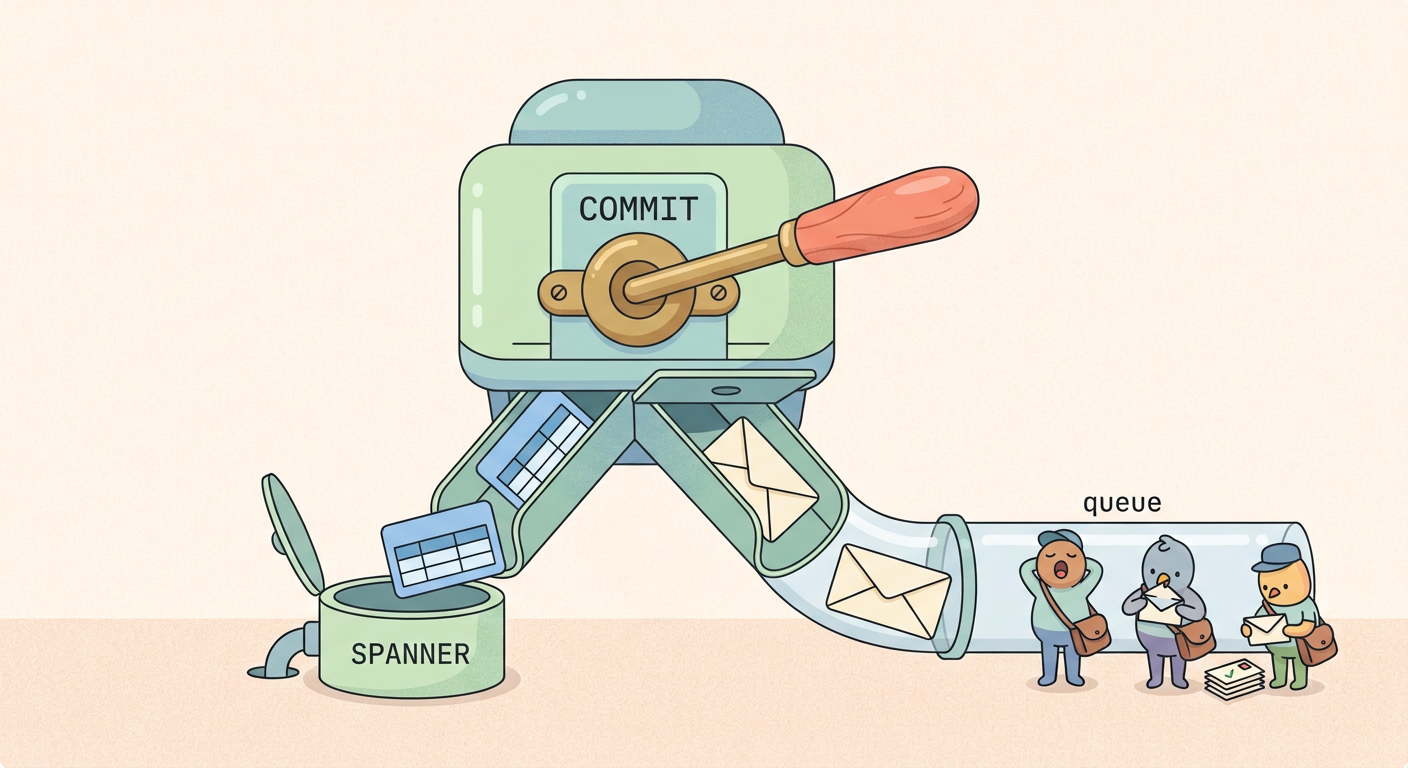
AI agents don't just answer queries — they can autonomously issue refunds, manage inventory, execute multi-step handoffs, and orchestrate sub-agents, to name but a few complex agentic workflows.
AI agents don't just answer queries — they can autonomously issue refunds, manage inventory, execute multi-step handoffs, and orchestrate sub-agents, to name but a few complex agentic workflows.
Today, we are excited to announce the general availability of Spanner queues: native transactional messaging embedded directly within Spanner. Designed specifically for reliable agentic execution, with Spanner queues, creating a message is simply another write in your transaction. An agent's state change and intended downstream actions commit together atomically or fail completely.
Compare this to traditional approaches: When a database state update succeeds, but the action dispatch fails, your AI agent decides to act but doesn’t execute. If the message dispatch succeeds but the state transaction rolls back, your agent executes an action based on an invalid state. In asynchronous multi-agent coordination, retries, speculation, and race conditions amplify these failures, forcing developers to build complex outbox patterns, idempotency layers, and reconciliation workers — a heavy reliability tax on agentic architecture.
Key capabilities for agentic architectures Spanner queues introduces several core capabilities to support these complex asynchronous workflows without introducing infrastructure overhead.
Atomic decide-and-act enqueue. Within a single Spanner read-write transaction, agents can update internal memory or state tables and enqueue tasks to peer agents simultaneously. Backed by Spanner's strict serializability and global external consistency, state changes and execution intent commit as a single atomic unit.
In context
- Topic: Cloud y Arquitectura — Nube pública, híbrida, costos y decisiones de infraestructura.
- Source: Google Cloud Blog
- Published: 02/10/2026
Continue reading at the original source →
Excerpt published automatically by the site radar. The full text belongs to its publisher and is linked above.
Why it matters
The cloud stopped being a technical decision a long time ago. Today it is a financial decision with technical consequences: capital investment gets swapped for monthly spend, and that swap suits some companies very well and others very badly.
My reading goes through who sees the bill. In organisations where cloud cost reaches the team that generates it, spend organises itself. Where only finance sees the bill, spend grows and the discussion becomes a blind cut every year end.
What usually goes wrong
What I see fail most is the literal migration. The system gets moved exactly as it was, nothing redesigned, and you end up paying hourly for what used to be paid once. It works the same, costs more, and two years later somebody asks why it was done. Lift and shift is not modernising.
What to watch
- What happens when the provider has an outage, because it will, and what keeps running meanwhile.
- Three-year total cost with real growth, not the first-year promotion.
- How hard it would be to leave or move a piece to another provider, which is future negotiating power.
How I read this entry
I would read it thinking about the exit before the entry. Not because anyone plans to leave, but because the conversation about how you would leave is the one that reveals how much you are locking in. If nobody at the table can describe that path, the dependency is already deeper than they think.
This entry is an excerpt from the original source, selected by the site radar. The commentary above is the site's own and does not belong to the cited publisher.
Comments
No comments yet. Yours can be the first.
Living through this in your own team?
Open the chat and tell me how you're handling it. I'm interested in comparing notes.

