Written by: Jayson Frost, Bryce Greathouse, Brian Meyer, John Palmisano, Rajesh Rajeshirke, Steve Rasch, John Wolfram Introduction On October 15, BeyondTrust disclosed a vulnerability, CVE-2026-102764, impacting BeyondTrust Remote Support (formerly Bomgar) appliances.
Written by: Jayson Frost, Bryce Greathouse, Brian Meyer, John Palmisano, Rajesh Rajeshirke, Steve Rasch, John Wolfram Introduction On October 15, BeyondTrust disclosed a vulnerability, CVE-2026-102764, impacting BeyondTrust Remote Support (formerly Bomgar) appliances.
During an incident response engagement, Mandiant identified evidence that ARMORY CASTLE, a suspected PRC-nexus espionage threat actor (formerly tracked as UNC5221), exploited this vulnerability as a zero-day, in late August 2026. This blog describes how ARMORY CASTLE escalated privileges and established persistent access to compromised BeyondTrust Remote Support appliances following exploitation of CVE-2026-102764, and provides actionable guidance for defenders.
Organizations should prepare for potential widespread exploitation following this disclosure, as ARMORY CASTLE and other threat actors have historically conducted broad, opportunistic exploitation once the vulnerability becomes public.
Exploitation Mandiant identified evidence of CVE-2026-102764 exploitation within the access, syslog, messages, thin-scc, brain and SSL log files, which are only accessible via an LUKS-encrypted partition which contains the /home directory. We strongly recommend that affected organizations immediately apply the security patches provided by BeyondTrust to remediate the vulnerability, and review additional guidance in their blog.
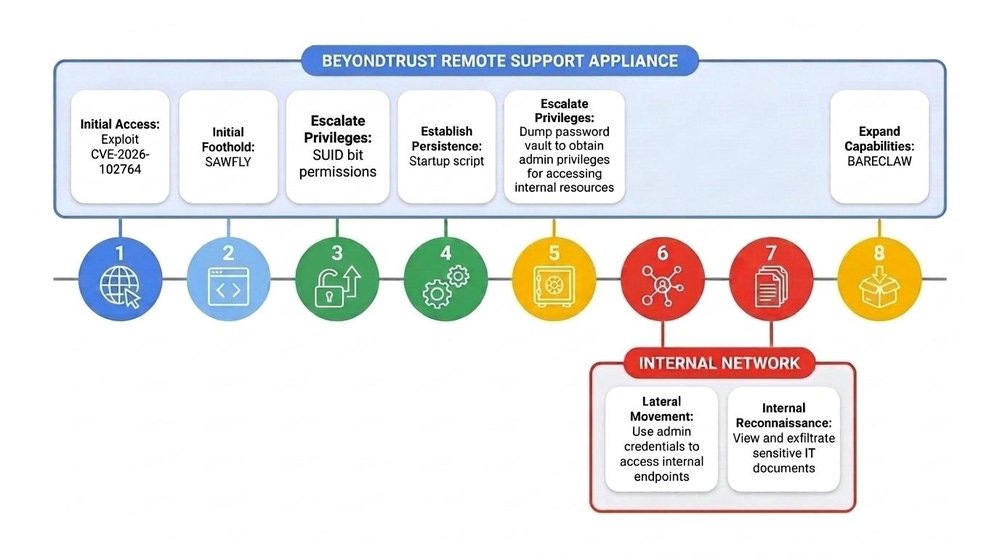
Post-Exploitation Following the successful exploitation of CVE-2026-102764, Mandiant observed ARMORY CASTLE leverage multiple distinct TTPs to establish a foothold, escalate privileges, and enable lateral movement. Throughout the intrusion, ARMORY CASTLE leveraged a deep understanding of BeyondTrust appliance internals, as evidenced by their abuse of proprietary CLI utilities, startup configuration templates and local reverse-proxy routing. The threat actor used newly identified custom malware, the SAWFLY webshell and the BARECLAW tunneler to interact with the BeyondTrust device. Additionally, the actor routinely deleted appliance logs and endpoint artifacts to maintain access and evade detection.
In context
- Topic: Ciberseguridad — Riesgo, identidad, respuesta a incidentes y cumplimiento.
- Source: Google Cloud Blog
- Published: 15/10/2026
Continue reading at the original source →
Excerpt published automatically by the site radar. The full text belongs to its publisher and is linked above.
Por qué importa
La mayoría de los incidentes que terminan siendo caros no empezaron con una técnica sofisticada. Empezaron con una cuenta que debió cerrarse cuando alguien renunció, un servidor que nadie sabía que seguía prendido, o un permiso amplio que se dio para salir del paso y quedó.
Separo el riesgo técnico del riesgo de negocio, porque no siempre coinciden. Una vulnerabilidad crítica en un sistema aislado importa menos que una mediana en el sistema que factura. Priorizar por severidad sin mirar dónde está el dinero es una forma cara de trabajar mucho y proteger poco.
Lo que suele salir mal
El punto ciego más caro suele ser el proveedor. Se blinda el perímetro propio y se le da acceso amplio a un tercero que no tiene ni la mitad de esos controles. Buena parte de los incidentes que he visto en la región entraron por ahí, y el contrato no decía nada al respecto.
Qué mirar
- Cómo se comunicó a clientes y reguladores, que es donde se define el costo reputacional.
- Si hubo terceros o proveedores en la cadena, porque el perímetro hoy incluye a los socios.
- Cuánto tardaron en detectarlo, que suele ser la métrica más reveladora de todo el caso.
Cómo leo esta entrada
Lo que yo revisaría esta misma semana son los accesos: cuentas de gente que ya no está, permisos que crecieron sin que nadie los recortara, y credenciales compartidas que todo el mundo jura que no existen. Es el trabajo menos vistoso y el que más ataques corta.
La noticia original está publicada en otro idioma; acá se cita el extracto tal como lo entrega el medio y el comentario se escribe en español.
Comentarios
Todavía no hay comentarios. El primero puede ser el tuyo.
¿Lo estás viviendo en tu equipo?
Abrí el chat y contame cómo lo están manejando. Me interesa comparar notas.