Written by: Jayson Frost, Bryce Greathouse, Brian Meyer, John Palmisano, Rajesh Rajeshirke, Steve Rasch, John Wolfram Introduction On October 15, BeyondTrust disclosed a vulnerability, CVE-2026-102764, impacting BeyondTrust Remote Support (formerly Bomgar) appliances.
Written by: Jayson Frost, Bryce Greathouse, Brian Meyer, John Palmisano, Rajesh Rajeshirke, Steve Rasch, John Wolfram Introduction On October 15, BeyondTrust disclosed a vulnerability, CVE-2026-102764, impacting BeyondTrust Remote Support (formerly Bomgar) appliances.
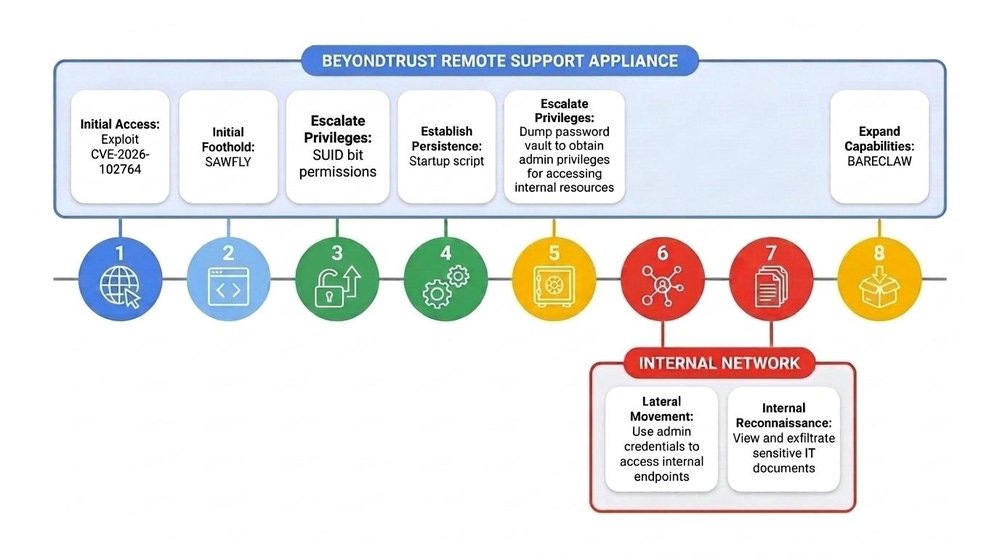
During an incident response engagement, Mandiant identified evidence that ARMORY CASTLE, a suspected PRC-nexus espionage threat actor (formerly tracked as UNC5221), exploited this vulnerability as a zero-day, in late August 2026. This blog describes how ARMORY CASTLE escalated privileges and established persistent access to compromised BeyondTrust Remote Support appliances following exploitation of CVE-2026-102764, and provides actionable guidance for defenders.
Organizations should prepare for potential widespread exploitation following this disclosure, as ARMORY CASTLE and other threat actors have historically conducted broad, opportunistic exploitation once the vulnerability becomes public.
Exploitation Mandiant identified evidence of CVE-2026-102764 exploitation within the access, syslog, messages, thin-scc, brain and SSL log files, which are only accessible via an LUKS-encrypted partition which contains the /home directory. We strongly recommend that affected organizations immediately apply the security patches provided by BeyondTrust to remediate the vulnerability, and review additional guidance in their blog.
Post-Exploitation Following the successful exploitation of CVE-2026-102764, Mandiant observed ARMORY CASTLE leverage multiple distinct TTPs to establish a foothold, escalate privileges, and enable lateral movement. Throughout the intrusion, ARMORY CASTLE leveraged a deep understanding of BeyondTrust appliance internals, as evidenced by their abuse of proprietary CLI utilities, startup configuration templates and local reverse-proxy routing. The threat actor used newly identified custom malware, the SAWFLY webshell and the BARECLAW tunneler to interact with the BeyondTrust device. Additionally, the actor routinely deleted appliance logs and endpoint artifacts to maintain access and evade detection.
In context
- Topic: Ciberseguridad — Riesgo, identidad, respuesta a incidentes y cumplimiento.
- Source: Google Cloud Blog
- Published: 15/10/2026
Continue reading at the original source →
Excerpt published automatically by the site radar. The full text belongs to its publisher and is linked above.
Por que importa
A maioria dos incidentes que acabam caros não começou com uma técnica sofisticada. Começou com uma conta que deveria ter sido fechada quando alguém pediu demissão, um servidor que ninguém sabia que continuava ligado, ou uma permissão ampla dada para resolver o momento e que ficou.
Separo o risco técnico do risco de negócio, porque nem sempre coincidem. Uma vulnerabilidade crítica num sistema isolado importa menos que uma média no sistema que fatura. Priorizar por severidade sem olhar onde está o dinheiro é um jeito caro de trabalhar muito e proteger pouco.
O que costuma dar errado
O ponto cego mais caro costuma ser o fornecedor. Blinda-se o perímetro próprio e dá-se acesso amplo a um terceiro que não tem metade desses controles. Boa parte dos incidentes que vi na região entrou por aí, e o contrato não dizia nada a respeito.
O que observar
- Como foi comunicado a clientes e reguladores, que é onde se define o custo reputacional.
- Se houve terceiros ou fornecedores na cadeia, porque o perímetro hoje inclui os parceiros.
- Quanto tempo levaram para detectar, que costuma ser a métrica mais reveladora do caso inteiro.
Como leio esta publicação
O que eu revisaria nesta mesma semana são os acessos: contas de gente que já saiu, permissões que cresceram sem ninguém cortar e credenciais compartilhadas que todo mundo jura que não existem. É o trabalho menos vistoso e o que mais corta ataques.
A notícia original está publicada em outro idioma; o trecho é citado como o veículo o entrega e o comentário é escrito em português.
Comentários
Ainda não há comentários. O primeiro pode ser o seu.
Está vivendo isso na sua equipe?
Abra o chat e me conte como estão lidando com isso. Tenho interesse em comparar notas.