
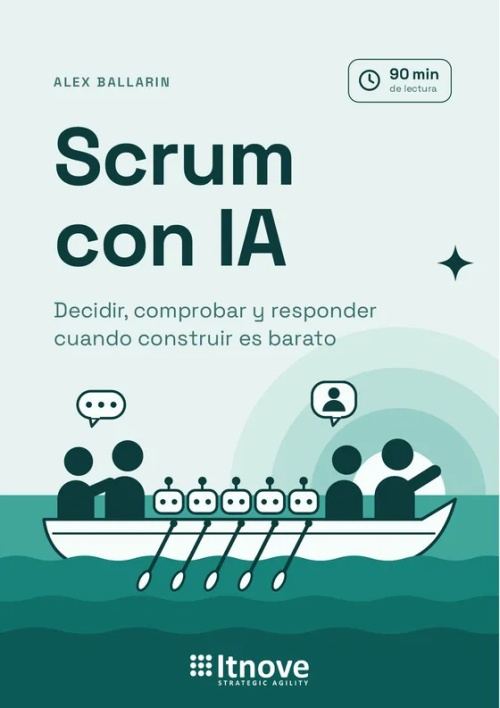
Image Ahora que un agente de IA escribe en una tarde lo que antes llevaba un Sprint, circula una conclusión rápida: si construir ya no cuesta, Scrum sobra. Jeff Gothelf la plantea en Product Management and AI (Sense & Respond Press, 2026).
Image Ahora que un agente de IA escribe en una tarde lo que antes llevaba un Sprint, circula una conclusión rápida: si construir ya no cuesta, Scrum sobra. Jeff Gothelf la plantea en Product Management and AI (Sense & Respond Press, 2026).
Creo que tiene razón en lo que critica y se equivoca en lo que concluye. Por eso he escrito Scrum con IA, un libro corto y gratuito sobre cómo usar Scrum para trabajar con IA con criterio. Te cuento de qué va y qué intenta aportarte.
La idea central: lo que la IA no abarataLa IA abarata construir. No abarata decidir qué construir, comprobar que funciona ni responder de ello. Scrum existe para lo segundo.
Si usabas Scrum para proteger la capacidad de un equipo de desarrollo escaso, con IA te sobra la mitad. Si lo usas para aprender rápido sin perder el control, te hace más falta que antes: inspeccionar y adaptar con evidencia, en ciclos cortos, con alguien que responde de lo que sale.
Gothelf acierta cuando critica el Scrum usado como fábrica de tickets. Pero lo que propone como alternativa (hipótesis, experimentos, medir cómo cambia el comportamiento de la gente y decidir con evidencia) es el empirismo de Scrum bien hecho. El libro parte de ahí y baja a lo concreto.
De qué va: el equipo que construye con agentes y la empresa que adopta la IAEl libro tiene dos vertientes. La primera es el equipo de desarrollo que ya trabaja con agentes: qué cambia en su Sprint, en sus eventos, en su Product Backlog y en su Definición de Terminado cuando el código llega mucho más rápido. La segunda es la empresa que adopta sus primeros casos de uso de IA y necesita priorizarlos, pilotarlos, medirlos y cumplir la normativa sin comprar licencias a ciegas.
In context
- Topic: Proyectos, PMO y Riesgos — Gestión de proyectos, oficinas de proyecto y riesgo del portafolio.
- Source: Scrum.org
- Published: 12/11/2026
Continue reading at the original source →
Excerpt published automatically by the site radar. The full text belongs to its publisher and is linked above.
Why it matters
Projects rarely fail on the day they are declared failed. They fail months earlier, in a meeting where somebody saw the problem coming and calculated it was not in their interest to say so. Everything else — the slipping schedule, the stretching budget — is the visible consequence of that silence.
My filter is the quality of the status report. If every project is green, the reporting system is not working: in any real portfolio some initiatives are in trouble, and a healthy organisation surfaces them in time rather than discovering them at the closure committee.
What usually goes wrong
What I see fail most is the absent sponsor. They sign the kick-off, appear in the photo, and do not come back until there is a problem. Without somebody with real authority clearing obstacles every fortnight, the project manager ends up negotiating as an equal with areas that do not report to them, and loses.
What to watch
- Which risks are identified, who owns each one, and when they were last reviewed.
- The size of the first useful delivery: the further out it is, the more it resembles a bet.
- How it was estimated and how close the same organisation's previous estimates turned out to be.
How I read this entry
If this landed on my desk, the first thing I would ask for is not percentage complete: it is the list of pending decisions with a name and a date. A percentage can be dressed up; a decision stuck for three weeks with an identified owner cannot be argued with, and it explains the delay far better.
This entry is an excerpt from the original source, selected by the site radar. The commentary above is the site's own and does not belong to the cited publisher.
Comments
No comments yet. Yours can be the first.
Living through this in your own team?
Open the chat and tell me how you're handling it. I'm interested in comparing notes.


