Image Now that an AI agent can write in an afternoon what used to take a Sprint, a quick conclusion is going around: if building no longer costs much, Scrum is no longer needed. Jeff Gothelf makes the case in Product Management and AI (Sense & Respond Press, 2026).
Image Now that an AI agent can write in an afternoon what used to take a Sprint, a quick conclusion is going around: if building no longer costs much, Scrum is no longer needed. Jeff Gothelf makes the case in Product Management and AI (Sense & Respond Press, 2026).
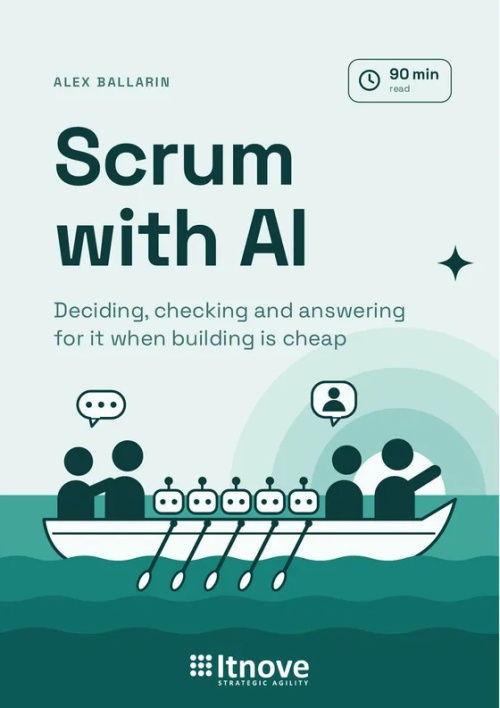
I think he is right about what he criticises and wrong about what he concludes. That is why I wrote Scrum with AI, a short, free book about how to use Scrum to work with AI with sound judgement. Here is what it is about and what it tries to give you.
The core idea: what AI does not make cheaperAI makes building cheap. It does not make it cheaper to decide what to build, to check that it works or to answer for it. Scrum exists for the second part.
If you used Scrum to protect the capacity of a scarce development team, with AI you no longer need half of it. If you use it to learn fast without losing control, you need it more than ever: inspecting and adapting with evidence, in short cycles, with someone who answers for the outcome.
Gothelf is right to criticise Scrum used as a ticket factory. But what he proposes instead (hypotheses, experiments, measuring how people's behaviour changes and deciding with evidence) is Scrum's empiricism done well. The book starts from there and gets concrete.
What it is about: the team that builds with agents and the company that adopts AIThe book has two sides. The first is the development team that already works with agents: what changes in its Sprint, its events, its Product Backlog and its Definition of Done when code arrives much faster. The second is the company that is adopting its first AI use cases and needs to prioritise them, pilot them, measure them and comply with regulation without buying licences blindly.
In context
- Topic: Proyectos, PMO y Riesgos — Gestión de proyectos, oficinas de proyecto y riesgo del portafolio.
- Source: Scrum.org
- Published: 12/11/2026
Continue reading at the original source →
Excerpt published automatically by the site radar. The full text belongs to its publisher and is linked above.
Por qué importa
En gestión de proyectos casi todo lo que se discute como problema técnico es en realidad un problema de expectativas mal negociadas al principio. Alcance, plazo y costo se pactaron en un momento en que nadie tenía la información suficiente, y después nadie quiso reabrir la conversación.
Leo estas cosas buscando dónde estaba el riesgo antes de convertirse en incidente. Casi siempre ya estaba escrito en algún registro que nadie revisaba, con un dueño asignado que nunca se enteró de que lo era. El riesgo identificado y no gestionado es peor que el no identificado: da la falsa sensación de que hay control.
Lo que suele salir mal
Donde suele romperse es en el traspaso a operación. El proyecto se declara terminado cuando se entrega, no cuando el área que lo recibe puede sostenerlo. Tres meses después el equipo se disolvió, nadie documentó nada y la operación convive con algo que no entiende y no puede modificar.
Qué mirar
- Quién es el patrocinador y con qué frecuencia real aparece — no en el organigrama, en la agenda.
- Si el reporte de estado muestra proyectos en rojo: un portafolio todo en verde es un portafolio sin información.
- Qué riesgos están identificados, quién es dueño de cada uno y cuándo se revisaron por última vez.
Cómo leo esta entrada
Si esto llegara a mi mesa, lo primero que pediría no es el avance porcentual: es la lista de decisiones pendientes con nombre y fecha. El porcentaje se puede maquillar; una decisión trabada hace tres semanas con un responsable identificado no se puede discutir, y explica el atraso mucho mejor.
La noticia original está publicada en otro idioma; acá se cita el extracto tal como lo entrega el medio y el comentario se escribe en español.
Comentarios
Todavía no hay comentarios. El primero puede ser el tuyo.
¿Lo estás viviendo en tu equipo?
Abrí el chat y contame cómo lo están manejando. Me interesa comparar notas.