
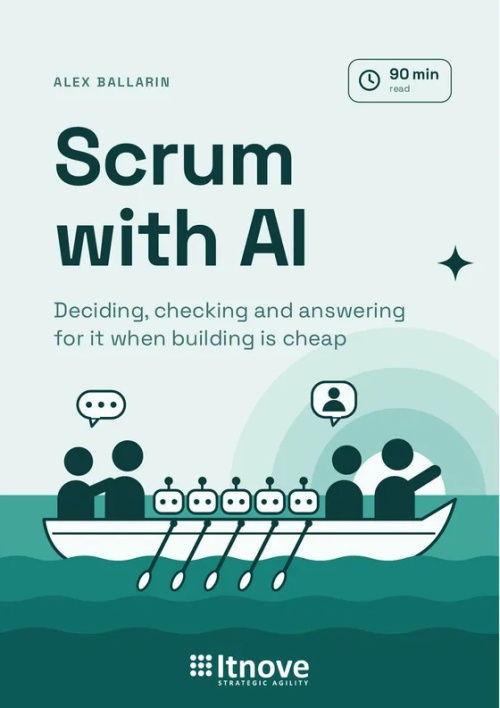
Image Now that an AI agent can write in an afternoon what used to take a Sprint, a quick conclusion is going around: if building no longer costs much, Scrum is no longer needed. Jeff Gothelf makes the case in Product Management and AI (Sense & Respond Press, 2026).
Image Now that an AI agent can write in an afternoon what used to take a Sprint, a quick conclusion is going around: if building no longer costs much, Scrum is no longer needed. Jeff Gothelf makes the case in Product Management and AI (Sense & Respond Press, 2026).
I think he is right about what he criticises and wrong about what he concludes. That is why I wrote Scrum with AI, a short, free book about how to use Scrum to work with AI with sound judgement. Here is what it is about and what it tries to give you.
The core idea: what AI does not make cheaperAI makes building cheap. It does not make it cheaper to decide what to build, to check that it works or to answer for it. Scrum exists for the second part.
If you used Scrum to protect the capacity of a scarce development team, with AI you no longer need half of it. If you use it to learn fast without losing control, you need it more than ever: inspecting and adapting with evidence, in short cycles, with someone who answers for the outcome.
Gothelf is right to criticise Scrum used as a ticket factory. But what he proposes instead (hypotheses, experiments, measuring how people's behaviour changes and deciding with evidence) is Scrum's empiricism done well. The book starts from there and gets concrete.
What it is about: the team that builds with agents and the company that adopts AIThe book has two sides. The first is the development team that already works with agents: what changes in its Sprint, its events, its Product Backlog and its Definition of Done when code arrives much faster. The second is the company that is adopting its first AI use cases and needs to prioritise them, pilot them, measure them and comply with regulation without buying licences blindly.
In context
- Topic: Proyectos, PMO y Riesgos — Gestión de proyectos, oficinas de proyecto y riesgo del portafolio.
- Source: Scrum.org
- Published: 12/11/2026
Continue reading at the original source →
Excerpt published automatically by the site radar. The full text belongs to its publisher and is linked above.
Why it matters
In project management, nearly everything discussed as a technical problem is really a problem of expectations badly negotiated at the start. Scope, time and cost were agreed at a moment when nobody had enough information, and afterwards nobody wanted to reopen the conversation.
I read these things looking for where the risk sat before it became an incident. It was almost always already written in some register nobody reviewed, with an assigned owner who never found out they were one. A risk identified and not managed is worse than one never identified: it creates the false sense that there is control.
What usually goes wrong
Where it usually breaks is the handover to operations. The project is declared finished when it is delivered, not when the receiving area can sustain it. Three months later the team has dissolved, nobody documented anything, and operations lives with something it does not understand and cannot change.
What to watch
- Who the sponsor is and how often they actually show up — not on the org chart, in the calendar.
- Whether the status report shows any red projects: an all-green portfolio is a portfolio without information.
- Which risks are identified, who owns each one, and when they were last reviewed.
How I read this entry
If this landed on my desk, the first thing I would ask for is not percentage complete: it is the list of pending decisions with a name and a date. A percentage can be dressed up; a decision stuck for three weeks with an identified owner cannot be argued with, and it explains the delay far better.
This entry is an excerpt from the original source, selected by the site radar. The commentary above is the site's own and does not belong to the cited publisher.
Comments
No comments yet. Yours can be the first.
Living through this in your own team?
Open the chat and tell me how you're handling it. I'm interested in comparing notes.


