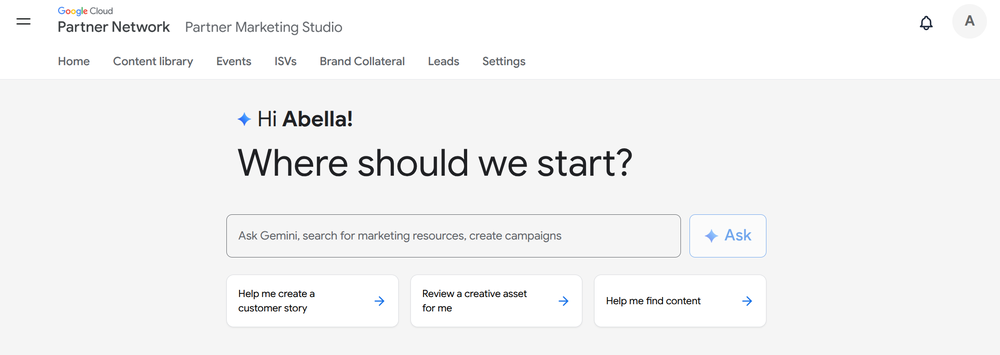
At Google Cloud, our commitment to agentic transformation extends to everyone, including the partners who build and grow alongside us. Today, we are excited to introduce new Gemini-powered co-marketing capabilities directly within everyday go-to-market workflows for our partners.
At Google Cloud, our commitment to agentic transformation extends to everyone, including the partners who build and grow alongside us. Today, we are excited to introduce new Gemini-powered co-marketing capabilities directly within everyday go-to-market workflows for our partners.
From marketing together to innovating together: Scaling impact with Gemini As technology evolves and customer expectations shift, marketers are no longer just producing campaigns. We’re building continuous, hyper-personalized, data-driven demand engines, and we’re doing it across an increasingly fragmented buyer journey.
For our partner network, delivering on this expectation means solving a dual challenge: differentiating core offerings while articulating a unified vision with Google Cloud.
Bridging that gap at enterprise scale requires more than incremental efficiency — it requires agentic agility to jointly create, adapt, and distribute stories together that resonate.
What’s new: Advanced agentic capabilities within Partner Marketing Studio The updated Partner Marketing Studio introduces a suite of agentic tools designed to accelerate campaign execution, optimize performance, and maximize impact for partners of all sizes.
Agentic search: Partners can now use a simple chat feature. Search for what you need, rather than navigating a content repository.
In context
- Topic: Cloud y Arquitectura — Nube pública, híbrida, costos y decisiones de infraestructura.
- Source: Google Cloud Blog
- Published: 19/11/2026
Continue reading at the original source →
Excerpt published automatically by the site radar. The full text belongs to its publisher and is linked above.
Why it matters
After a few years, nearly every organisation that migrated discovers the same thing: the bill grows faster than the business. Not because the cloud is expensive, but because nobody switches off what is no longer used and nobody has the incentive to check.
What I look at in these announcements is portability. The more comfortable a platform is, the harder it usually is to leave, and that comfort gets paid for in negotiating power three years later, exactly when renewal comes up and there is no credible alternative left.
What usually goes wrong
Where it usually breaks is team capability. The platform is new but people learned on the fly, with no time and no support. They end up replicating data-centre practices in the cloud, which means paying cloud prices for benefits that never arrive.
What to watch
- What happens when the provider has an outage, because it will, and what keeps running meanwhile.
- Three-year total cost with real growth, not the first-year promotion.
- How hard it would be to leave or move a piece to another provider, which is future negotiating power.
How I read this entry
If this fed into an infrastructure decision, I would ask for the three-year total cost with real growth built in, not year one with the entry discount. Most cloud surprises live in year two, when the discount ends and the volume has already gone up.
This entry is an excerpt from the original source, selected by the site radar. The commentary above is the site's own and does not belong to the cited publisher.
Comments
No comments yet. Yours can be the first.
Living through this in your own team?
Open the chat and tell me how you're handling it. I'm interested in comparing notes.