
AI can reduce the time it takes to create code and documents. But if we focus only on how much a team produces or how quickly it works, we risk losing sight of what the team has learned and what has changed for its customers.For a team using AI, a crucial part of its work is experimenting and making decisions.
AI can reduce the time it takes to create code and documents. But if we focus only on how much a team produces or how quickly it works, we risk losing sight of what the team has learned and what has changed for its customers.For a team using AI, a crucial part of its work is experimenting and making decisions.
Learning in Pursuit of a MissionWhether a team is learning depends on what it needs to learn. Its mission gives it a direction, and the team needs to be able to decide for itself what it should learn along the way.
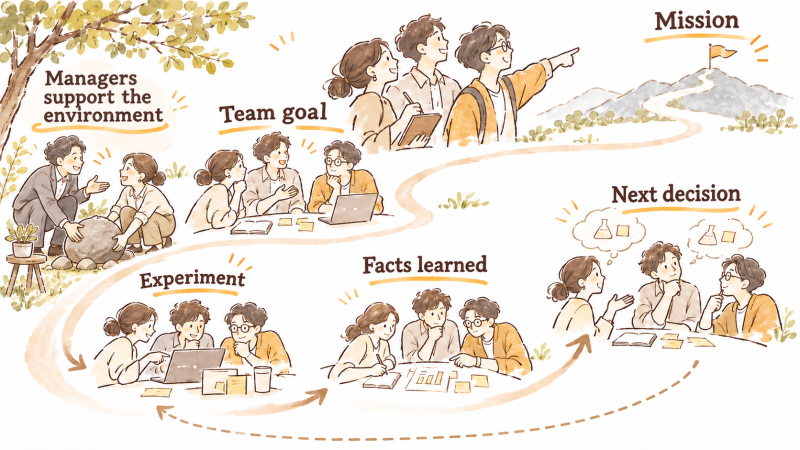
The manager who has provided that mission should look at whether the team is moving toward it. The team's approach may differ from the one the manager initially had in mind. Even so, the manager can assess whether the team is working toward goals it has set for itself and conducting experiments along the way. It is also important to look at what facts the team has discovered through those experiments and how it has used them in its next decisions.
Figure 1. Team learning toward a mission, supported by a manager
In situations of high uncertainty and complexity, managers themselves often do not know the right answer, even if, like anyone else, they may find that hard to admit. In those situations, the team's own decisions and experiments should take precedence over following the particular tasks a manager had in mind.
Use AI to Support Experiments and DecisionsAI is well suited to helping teams collect and evaluate data and evidence for their decisions. Code generation, for example, can be seen as one means of conducting an experiment.
In context
- Topic: Inteligencia Artificial — IA aplicada al negocio: casos, límites, costos y gobierno.
- Source: Scrum.org
- Published: 17/11/2026
Continue reading at the original source →
Excerpt published automatically by the site radar. The full text belongs to its publisher and is linked above.
Why it matters
In project management, nearly everything discussed as a technical problem is really a problem of expectations badly negotiated at the start. Scope, time and cost were agreed at a moment when nobody had enough information, and afterwards nobody wanted to reopen the conversation.
My filter is the quality of the status report. If every project is green, the reporting system is not working: in any real portfolio some initiatives are in trouble, and a healthy organisation surfaces them in time rather than discovering them at the closure committee.
What usually goes wrong
The classic mistake is treating risk management as a deliverable of the planning phase. The matrix gets built, approved, filed. Nobody opens it again until closure, when it serves to document that the risk was foreseen — which is exactly the opposite of managing it.
What to watch
- The size of the first useful delivery: the further out it is, the more it resembles a bet.
- How it was estimated and how close the same organisation's previous estimates turned out to be.
- Who the sponsor is and how often they actually show up — not on the org chart, in the calendar.
How I read this entry
If this landed on my desk, the first thing I would ask for is not percentage complete: it is the list of pending decisions with a name and a date. A percentage can be dressed up; a decision stuck for three weeks with an identified owner cannot be argued with, and it explains the delay far better.
This entry is an excerpt from the original source, selected by the site radar. The commentary above is the site's own and does not belong to the cited publisher.
Comments
No comments yet. Yours can be the first.
Living through this in your own team?
Open the chat and tell me how you're handling it. I'm interested in comparing notes.


