How to simplify cloud access with Unified Access Policies, now in preview
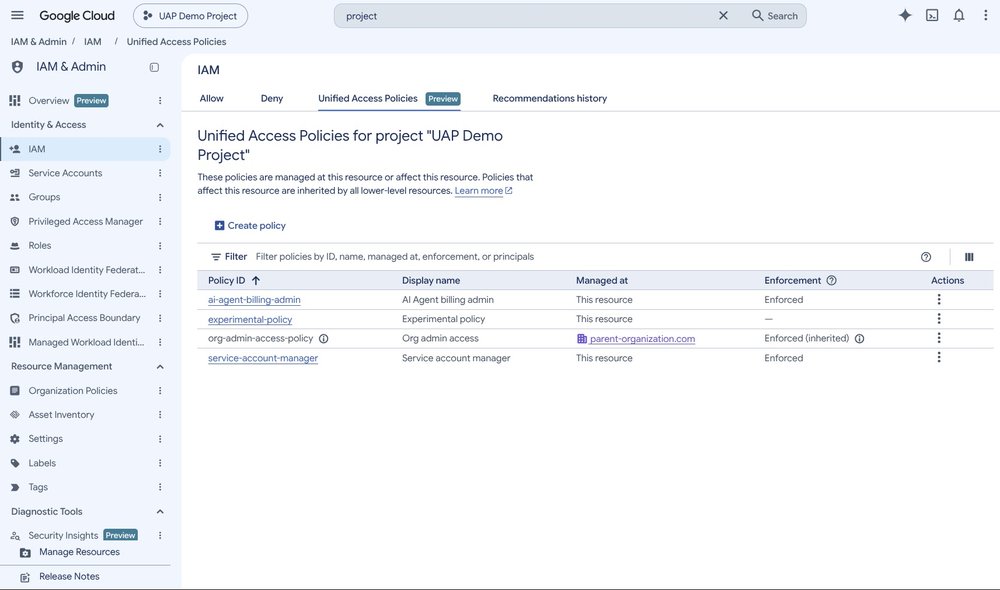
As organizations scale their cloud footprint to thousands of autonomous agents and microservices, you can accidentally create an operational bottleneck with strict Identity and Access Management (IAM).
As organizations scale their cloud footprint to thousands of autonomous agents and microservices, you can accidentally create an operational bottleneck with strict Identity and Access Management (IAM).
Enter Unified Access Policies (UAPs), Google Cloud's next-generation access control engine in Cloud IAM, now in preview at no additional cost. UAP consolidates allow and deny rules into one unified schema, and decouples policy definition from resource enforcement.
This approach allows you to author a policy once and bind it across your organization. UAP governs human, workload, and first-class agent identities with your existing IAM policies. With UAP, you can radically simplify your access policies and manage them more easily at scale.
Scale limitations of legacy access models Traditional access policy models can push teams into a tough trade-off between Zero Trust access and pipeline speed due to three compounding forces:
Fragmented schemas and permission sprawl: In granting thousands of granular permissions across cloud resources, administrators are forced to choose between either over-granting permissions from coarse roles with broad access, or wrangling two different syntaxes (APIs and mental models across allow and deny) just to define one workload's custom access posture.
Policies treated as snowflakes: Because legacy policies attach directly to individual resources, applying a standard developer or security baseline across 25 projects means duplicating and maintaining 50 separate allow and deny policy configurations in Terraform. This approach can create severe configuration fatigue and operational burden, with greater risk of misconfiguration.
In context
- Topic: Cloud y Arquitectura — Nube pública, híbrida, costos y decisiones de infraestructura.
- Source: Google Cloud Blog
- Published: 20/11/2026
Continue reading at the original source →
Excerpt published automatically by the site radar. The full text belongs to its publisher and is linked above.
Why it matters
The cloud stopped being a technical decision a long time ago. Today it is a financial decision with technical consequences: capital investment gets swapped for monthly spend, and that swap suits some companies very well and others very badly.
My reading goes through who sees the bill. In organisations where cloud cost reaches the team that generates it, spend organises itself. Where only finance sees the bill, spend grows and the discussion becomes a blind cut every year end.
What usually goes wrong
Where it usually breaks is team capability. The platform is new but people learned on the fly, with no time and no support. They end up replicating data-centre practices in the cloud, which means paying cloud prices for benefits that never arrive.
What to watch
- Where the data physically sits and what local regulation demands about that.
- What happens when the provider has an outage, because it will, and what keeps running meanwhile.
- Three-year total cost with real growth, not the first-year promotion.
How I read this entry
I would read it thinking about the exit before the entry. Not because anyone plans to leave, but because the conversation about how you would leave is the one that reveals how much you are locking in. If nobody at the table can describe that path, the dependency is already deeper than they think.
This entry is an excerpt from the original source, selected by the site radar. The commentary above is the site's own and does not belong to the cited publisher.
Comments
No comments yet. Yours can be the first.
Living through this in your own team?
Open the chat and tell me how you're handling it. I'm interested in comparing notes.