Editor's note: Generative AI startups are moving rapidly beyond static clip generation to build interactive, real-time worlds. In this technical deep dive, we explore how AI startup Visko collaborated with Google Cloud TPU engineers to deploy Orbis — its continuously streaming Live World Model—on Cloud TPUs, going from…
Editor's note: Generative AI startups are moving rapidly beyond static clip generation to build interactive, real-time worlds. In this technical deep dive, we explore how AI startup Visko collaborated with Google Cloud TPU engineers to deploy Orbis — its continuously streaming Live World Model—on Cloud TPUs, going from…
What makes a live video world model so challenging to serve in production? The bottleneck isn't average throughput — it's beating a relentless real-time clock. Unlike offline video generators where a user submits a prompt and waits in a queue, a live world model streams continuously. Every new chunk of video and synchronized audio must finish rendering before the viewer finishes watching the previous one, or the world freezes.
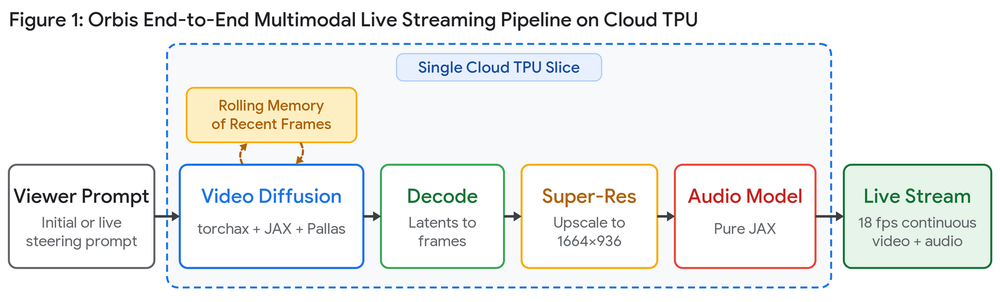
Today, we're excited to share how Visko, an AI startup pioneering interactive world models, teamed up with Google Cloud to solve this exact challenge. Working side by side, Visko and Google Cloud engineers deployed Visko's end-to-end live inference pipeline — combining video generation, super-resolution upscaling, and synchronized audio—onto a single Cloud TPU slice. Together, the teams brought end-to-end generation down, rendering at 1.07x playback speed.
Here is an inside look at how we engineered the pipeline to hit that milestone in a single month, the architectural optimizations that moved the needle, and practical lessons for other startups building ultra-low-latency generative AI on Google Cloud.
Redefining interactive media with Live World Models While most generative video platforms focus on rendering fixed, pre-baked clips, Visko is building what it calls Live Models: video world models that generate continuously and respond on the fly.
Visko's flagship model, Orbis, streams live video starting from a single text or image prompt. As the stream plays, viewers can enter new steering prompts in real time, dynamically evolving the scene without restarting or breaking continuity. For instance, in one test session, the livestream opens on a cat napping beside a crackling fireplace; when the viewer steers the scene to introduce a bowl of food, the bowl materializes seamlessly, and the cat stretches, stands up, and meows.
In context
- Topic: Cloud y Arquitectura — Nube pública, híbrida, costos y decisiones de infraestructura.
- Source: Google Cloud Blog
- Published: 15/10/2026
Continue reading at the original source →
Excerpt published automatically by the site radar. The full text belongs to its publisher and is linked above.
Por qué importa
Después de unos años, casi toda organización que migró a la nube descubre lo mismo: la factura crece más rápido que el negocio. No porque la nube sea cara, sino porque nadie apaga lo que ya no se usa y nadie tiene el incentivo de revisarlo.
Lo que yo miro en estos anuncios es la portabilidad. Mientras más cómoda es una plataforma, más difícil suele ser salir de ella, y esa comodidad se paga en poder de negociación tres años después, justo cuando toca renovar y ya no hay alternativa creíble.
Lo que suele salir mal
El error que se repite es no dimensionar el tráfico de salida. Los cálculos se hacen con el costo de cómputo y almacenamiento, que son los visibles, y la sorpresa llega con la transferencia de datos. Es la línea de la factura que más veces vi desarmar un caso de negocio bien armado.
Qué mirar
- Dónde quedan físicamente los datos y qué exige la regulación local sobre eso.
- Qué pasa cuando el proveedor tiene una caída, porque la va a tener, y qué queda operando mientras tanto.
- El costo total a tres años con crecimiento real, no la promoción del primer año.
Cómo leo esta entrada
Si esto entrara en una decisión de infraestructura, yo pediría el costo total a tres años con el crecimiento real puesto adentro, no el del primer año con descuento de entrada. La mayoría de las sorpresas de nube están en el año dos, cuando el descuento se acaba y el volumen ya subió.
La noticia original está publicada en otro idioma; acá se cita el extracto tal como lo entrega el medio y el comentario se escribe en español.
Comentarios
Todavía no hay comentarios. El primero puede ser el tuyo.
¿Lo estás viviendo en tu equipo?
Abrí el chat y contame cómo lo están manejando. Me interesa comparar notas.