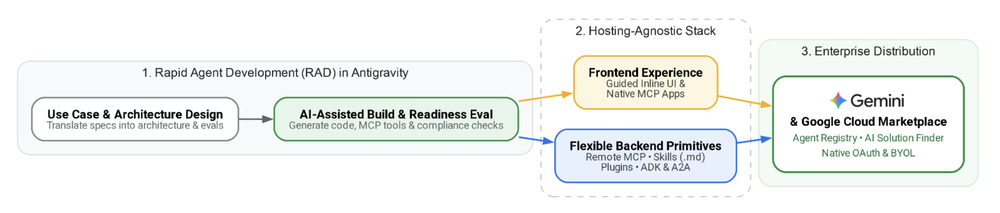
With the new unified Gemini experience, enterprises can bring third-party partner capabilities directly in Gemini through standardized connectors (spanning Model Context Protocol (MCP), Agent-to-Agent (A2A) runtimes, and REST APIs), alongside emerging declarative skills and plugins.
With the new unified Gemini experience, enterprises can bring third-party partner capabilities directly in Gemini through standardized connectors (spanning Model Context Protocol (MCP), Agent-to-Agent (A2A) runtimes, and REST APIs), alongside emerging declarative skills and plugins.
For independent software vendors (ISVs), this unified architecture unlocks a powerful opportunity to embed domain-specialized intelligence, regulated workflows, and live systems of record directly into enterprises' daily workflows. Yet turning a compelling use case into an enterprise-ready integration often stalls in engineering friction, from choosing the right extensibility primitive and wiring authentication to orchestrating multi-step tool execution and rendering inline interactive experiences.
To eliminate these bottlenecks, Google Cloud launched the Gemini factory—an intensive co-innovation initiative designed to help enterprise software partners go from a blank whiteboard to agentic solutions listed on Google Cloud Marketplace in record time. Through hands-on workshops in global technology hubs—including San Francisco, New York City, Sunnyvale, London, Paris, Tel Aviv, and Tokyo—Google Cloud specialists work side-by-side with partner teams to ideate, architect, and build the next generation of enterprise AI solutions with Gemini.
Choose the right agentic architecture across MCP connectors, skills, plugins, and autonomous agents.
Go from an initial use case to a production integration in days rather than months.
Accelerate customer activation with funding incentives and go-to-market (GTM) support.
In context
- Topic: Inteligencia Artificial — IA aplicada al negocio: casos, límites, costos y gobierno.
- Source: Google Cloud Blog
- Published: 10/11/2026
Continue reading at the original source →
Excerpt published automatically by the site radar. The full text belongs to its publisher and is linked above.
Why it matters
Every week there is an announcement that promises to change everything, and every week most organisations are still fighting the same battle: messy data, processes nobody documented, and expectations running faster than capability. This story reads better with that in the background.
The first thing I look at is not model capability but the data feeding it. Almost every project I have seen fail did not fail on the algorithm. It failed because the data lived in three systems with three different definitions and nobody wanted to be the one to fix that.
What usually goes wrong
The point where it usually breaks is the handover to operations. The team that built the pilot knows how to read the results; the team receiving it does not. Without training and written criteria, people start accepting everything the model says or ignoring it entirely, and both are equally expensive.
What to watch
- Where the data ends up and under what contract, especially when customer information is involved.
- Whether the organisation can change provider without rebuilding everything, which is the proof it did not get locked in.
- Which concrete process is touched and how it is measured before and after; with no baseline there is no result, only opinion.
How I read this entry
If I had to bring this into an organisation, I would start with a boring, measurable process — reconciliation, first-line support, document review — and get it running with a metric before touching anything flashy. The credibility for big projects is bought with a small result nobody can argue with.
This entry is an excerpt from the original source, selected by the site radar. The commentary above is the site's own and does not belong to the cited publisher.
Comments
No comments yet. Yours can be the first.
Living through this in your own team?
Open the chat and tell me how you're handling it. I'm interested in comparing notes.