Modernizing Unstructured Data Workflows: Alteryx Live Query meets Google Cloud BigQuery
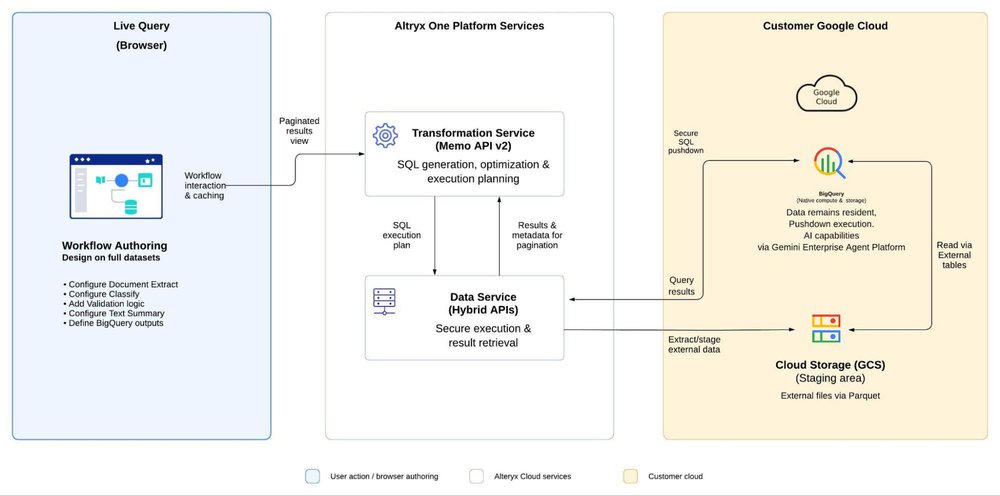
Alteryx One Live Query and Google Cloud BigQuery redefine how enterprises handle complex, unstructured data at scale by reducing reliance on disconnected tools, minimizing data movement, and enabling warehouse-native execution.
Alteryx One Live Query and Google Cloud BigQuery redefine how enterprises handle complex, unstructured data at scale by reducing reliance on disconnected tools, minimizing data movement, and enabling warehouse-native execution.
Live Query provides an intuitive, browser-based environment that allows business users to build sophisticated data pipelines without writing a single line of code. When paired with the scale and performance of BigQuery, this duo enables secure SQL pushdown, meaning data transformation logic is executed directly within the warehouse rather than moving it across the network. This synergy is particularly potent for document-heavy workflows, where Live Query can orchestrate Google’s advanced AI and machine learning models — like Gemini — to extract intelligence from PDFs and images while maintaining the strict data governance and security of the BigQuery environment.
From invoice PDFs to govern exception reporting in BigQuery with Live Query Finance and operations teams often find themselves buried under a mountain of vendor invoices. These documents come as PDFs with inconsistent data, varying invoice number formats, and a high risk of manual error. Traditionally, data teams have had to resort to manual data extraction or use a fragmented series of tools to move data into a warehouse — a process that is both time-consuming and prone to duplicates or amount mismatches.
With the integration of Live Query for BigQuery, you can now automate the entire lifecycle of an invoice. By processing PDFs, extracting key fields, and standardizing results directly within the BigQuery ecosystem, data teams can identify exceptions like anomalies or data issues within the documents faster while ensuring their governed enterprise data configured through the BigQuery fine grained access policies never has to leave the warehouse.
In context
- Topic: Cloud y Arquitectura — Nube pública, híbrida, costos y decisiones de infraestructura.
- Source: Google Cloud Blog
- Published: 09/10/2026
Continue reading at the original source →
Excerpt published automatically by the site radar. The full text belongs to its publisher and is linked above.
Por qué importa
El discurso de la nube pasó de migrar todo a decidir qué va dónde. Esa madurez es buena señal, pero también hace más difícil la conversación: ya no hay una respuesta única, hay que argumentar caso por caso y muy poca gente tiene los números para hacerlo.
Separo lo que se mueve por costo de lo que se mueve por capacidad. Migrar para ahorrar casi nunca funciona; migrar para poder hacer algo que antes no se podía, sí. Cuando el argumento es solo de ahorro, conviene revisar los números otra vez porque suelen estar incompletos.
Lo que suele salir mal
El error que se repite es no dimensionar el tráfico de salida. Los cálculos se hacen con el costo de cómputo y almacenamiento, que son los visibles, y la sorpresa llega con la transferencia de datos. Es la línea de la factura que más veces vi desarmar un caso de negocio bien armado.
Qué mirar
- Qué tan difícil sería salir o mover una parte a otro proveedor, que es el poder de negociación futuro.
- Quién ve la factura y con qué detalle: sin dueño del gasto, el gasto crece solo.
- Dónde quedan físicamente los datos y qué exige la regulación local sobre eso.
Cómo leo esta entrada
Yo lo leería pensando en la salida antes que en la entrada. No porque uno planee irse, sino porque la conversación de cómo saldría es la que revela cuánto se está amarrando. Si nadie en la mesa puede describir ese camino, la dependencia ya es mayor de lo que se cree.
La noticia original está publicada en otro idioma; acá se cita el extracto tal como lo entrega el medio y el comentario se escribe en español.
Comentarios
Todavía no hay comentarios. El primero puede ser el tuyo.
¿Lo estás viviendo en tu equipo?
Abrí el chat y contame cómo lo están manejando. Me interesa comparar notas.