
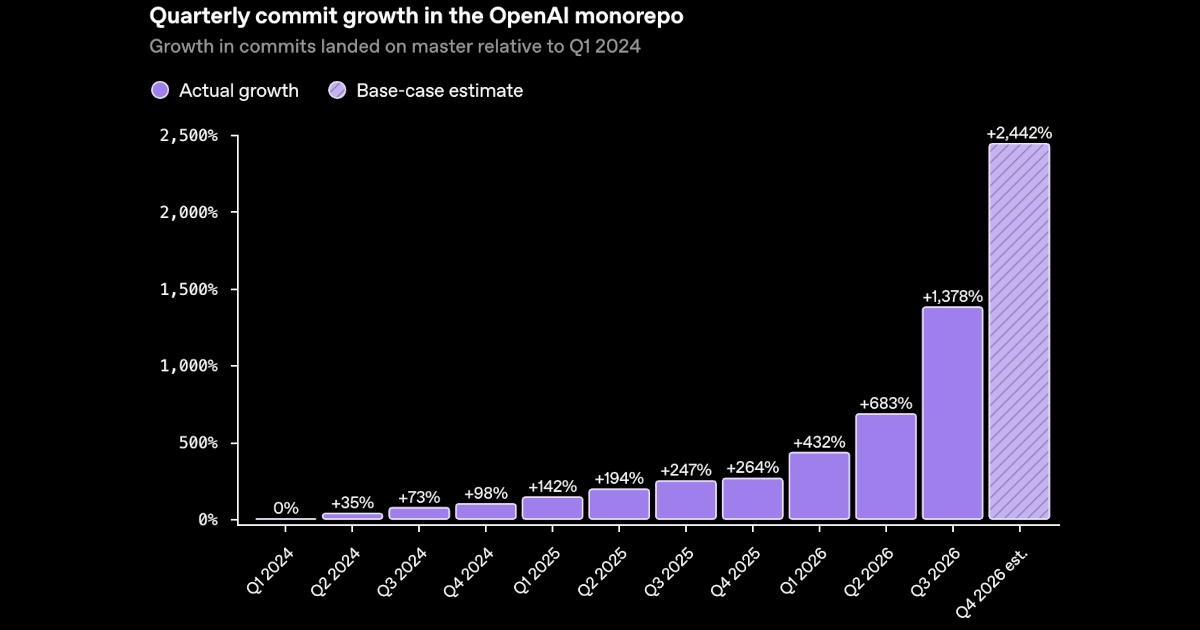
OpenAI has detailed Pando, a new backend that scales Git for concurrent coding-agent workloads without replacing familiar Git workflows. The company reports nearly 80% lower median push latency by coordinating branch updates independently and reusing stored packfiles across fetches. By Eran Stiller
OpenAI has detailed Pando, a new backend that scales Git for concurrent coding-agent workloads without replacing familiar Git workflows. The company reports nearly 80% lower median push latency by coordinating branch updates independently and reusing stored packfiles across fetches. By Eran Stiller
In context
- Topic: Inteligencia Artificial — IA aplicada al negocio: casos, límites, costos y gobierno.
- Source: InfoQ
- Published: 24/11/2026
Continue reading at the original source →
Excerpt published automatically by the site radar. The full text belongs to its publisher and is linked above.
Why it matters
Every week there is an announcement that promises to change everything, and every week most organisations are still fighting the same battle: messy data, processes nobody documented, and expectations running faster than capability. This story reads better with that in the background.
I measure AI maturity with an uncomfortable question: can anyone explain, in one line, what decision the model makes and who answers if it gets it wrong? Where that is clear, the project moves. Where it is not, it stays in permanent pilot and gets cancelled with the excuse that the technology was not ready.
What usually goes wrong
The mistake I have seen repeat most is measuring nothing before starting. It gets deployed, everybody feels things improved, and when somebody asks by how much, there is no answer. Without a baseline there is no way to defend next year's budget, and that is where good projects die.
What to watch
- Which concrete process is touched and how it is measured before and after; with no baseline there is no result, only opinion.
- Who reviews the model outputs and how often — the point at which AI becomes auditable.
- Cost per query at real volume, not pilot volume: the variable that produces the most surprises.
How I read this entry
My practical advice is to fix on day one what happens when the model is wrong: who reviews, how often, and at what point it gets switched off. It sounds defensive, but it is exactly what lets you be aggressive later, because the risk stopped being an unknown.
This entry is an excerpt from the original source, selected by the site radar. The commentary above is the site's own and does not belong to the cited publisher.
Comments
No comments yet. Yours can be the first.
Living through this in your own team?
Open the chat and tell me how you're handling it. I'm interested in comparing notes.


