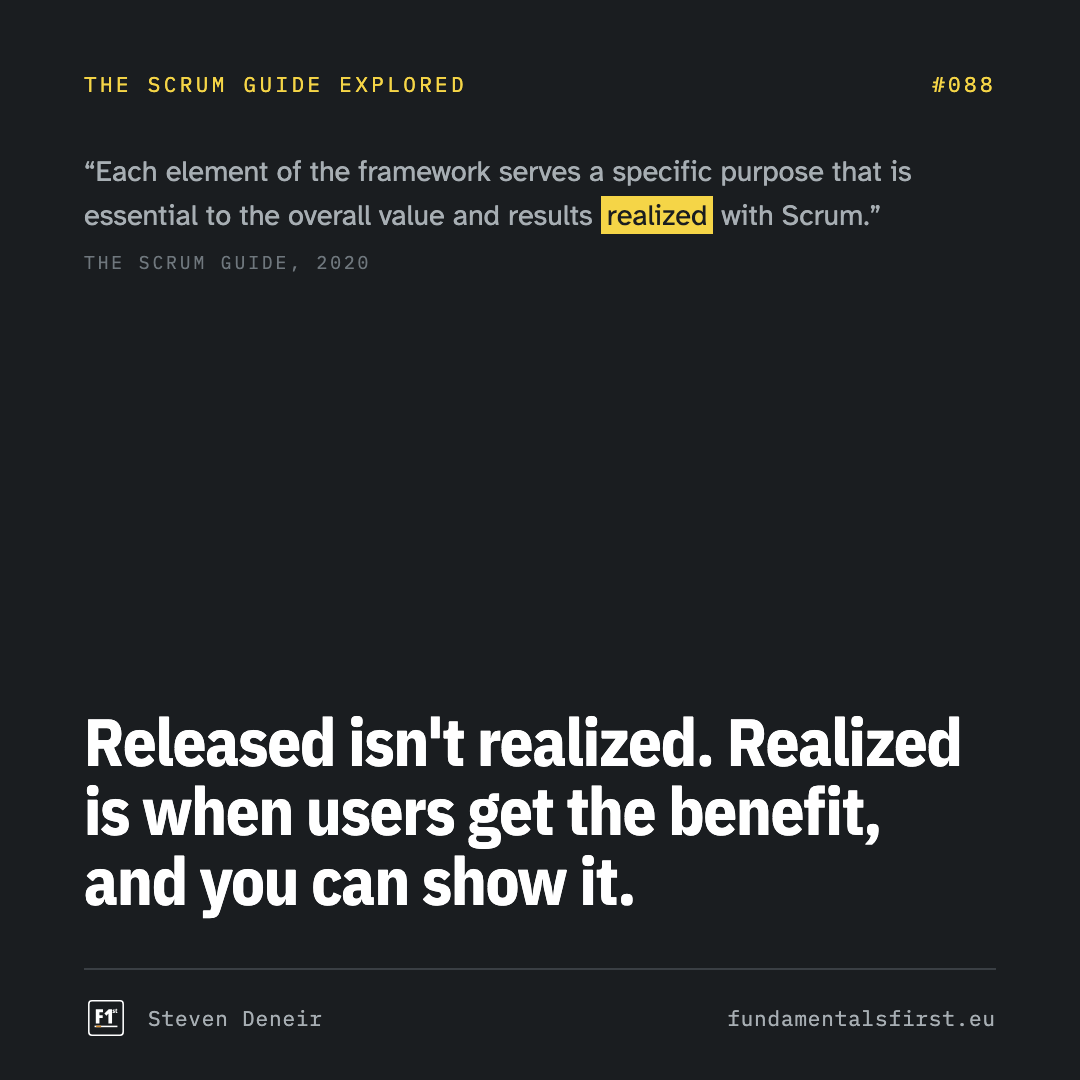
Most teams have a pretty good view on their next release date. Almost no team has a date to check whether users got the benefit.From the Scrum Guide: "Each element of the framework serves a specific purpose that is essential to the overall value and results realized with Scrum."The Cambridge Dictionary defines realize…
Most teams have a pretty good view on their next release date. Almost no team has a date to check whether users got the benefit.From the Scrum Guide: "Each element of the framework serves a specific purpose that is essential to the overall value and results realized with Scrum."The Cambridge Dictionary defines realize…
The Cambridge Dictionary defines realize as "to achieve things you hope for or plan for."
Hold that against how teams usually count. They plan an item, build it, release it and call it done. A release puts something in the hands of users, and that's where realizing value and results can start. Value is realized when the users get the outcome and the benefit you expected, and your team has the evidence to show it.
So in my classes and in coaching, I ask: how do you know the value of what you released was realized? It usually goes silent. The honest answer people give me is that it just isn't monitored. The team keeps producing, and nobody knows whether what it made gets used, let alone whether users get the benefit it was meant to bring.
And what you expect often doesn't happen. When Microsoft tested ideas in controlled experiments, less than a third moved the metric they were designed to improve (Kohavi and colleagues, 2013). The rest made no difference or made things worse. A team that never checks can't tell which of its releases landed. It plans the next ones on guesses.
Teams that do check get something back. DORA's 2023 Accelerate State of DevOps report found that teams with a strong user focus have 40% higher organizational performance. That focus includes using user feedback to decide what comes next, and judging a team's success by the value it brings users. It's survey data, so treat it as direction, and let your own releases show whether it holds for you.
In context
- Topic: Proyectos, PMO y Riesgos — Gestión de proyectos, oficinas de proyecto y riesgo del portafolio.
- Source: Scrum.org
- Published: 26/11/2026
Continue reading at the original source →
Excerpt published automatically by the site radar. The full text belongs to its publisher and is linked above.
Por qué importa
Los proyectos rara vez fracasan el día que se declaran fracasados. Fracasan meses antes, en una reunión donde alguien vio venir el problema y calculó que no le convenía decirlo. Todo lo demás —el cronograma que se corre, el presupuesto que se estira— es la consecuencia visible de ese silencio.
Lo que yo miro primero en un caso así no es el plan, es la frecuencia con la que se corrige. Un proyecto que replanifica cada mes con datos frescos llega mucho más cerca que uno que defiende durante un año la línea base que firmó cuando menos sabía.
Lo que suele salir mal
Lo que más veo fallar es el patrocinador ausente. Firma el inicio, aparece en la foto y después no vuelve hasta que hay un problema. Sin alguien con poder real que despeje obstáculos cada quince días, el jefe de proyecto termina negociando de igual a igual con áreas que no le reportan, y pierde.
Qué mirar
- Quién es el patrocinador y con qué frecuencia real aparece — no en el organigrama, en la agenda.
- Si el reporte de estado muestra proyectos en rojo: un portafolio todo en verde es un portafolio sin información.
- Qué riesgos están identificados, quién es dueño de cada uno y cuándo se revisaron por última vez.
Cómo leo esta entrada
Yo lo usaría para revisar cómo se estima en la organización. Si las estimaciones históricas se pasaron sistemáticamente por la mitad y nadie ajustó el método, no hay proyecto que salga bien: se está planificando con un metro que mide corto y culpando al equipo por no llegar.
La noticia original está publicada en otro idioma; acá se cita el extracto tal como lo entrega el medio y el comentario se escribe en español.
Comentarios
Todavía no hay comentarios. El primero puede ser el tuyo.
¿Lo estás viviendo en tu equipo?
Abrí el chat y contame cómo lo están manejando. Me interesa comparar notas.