
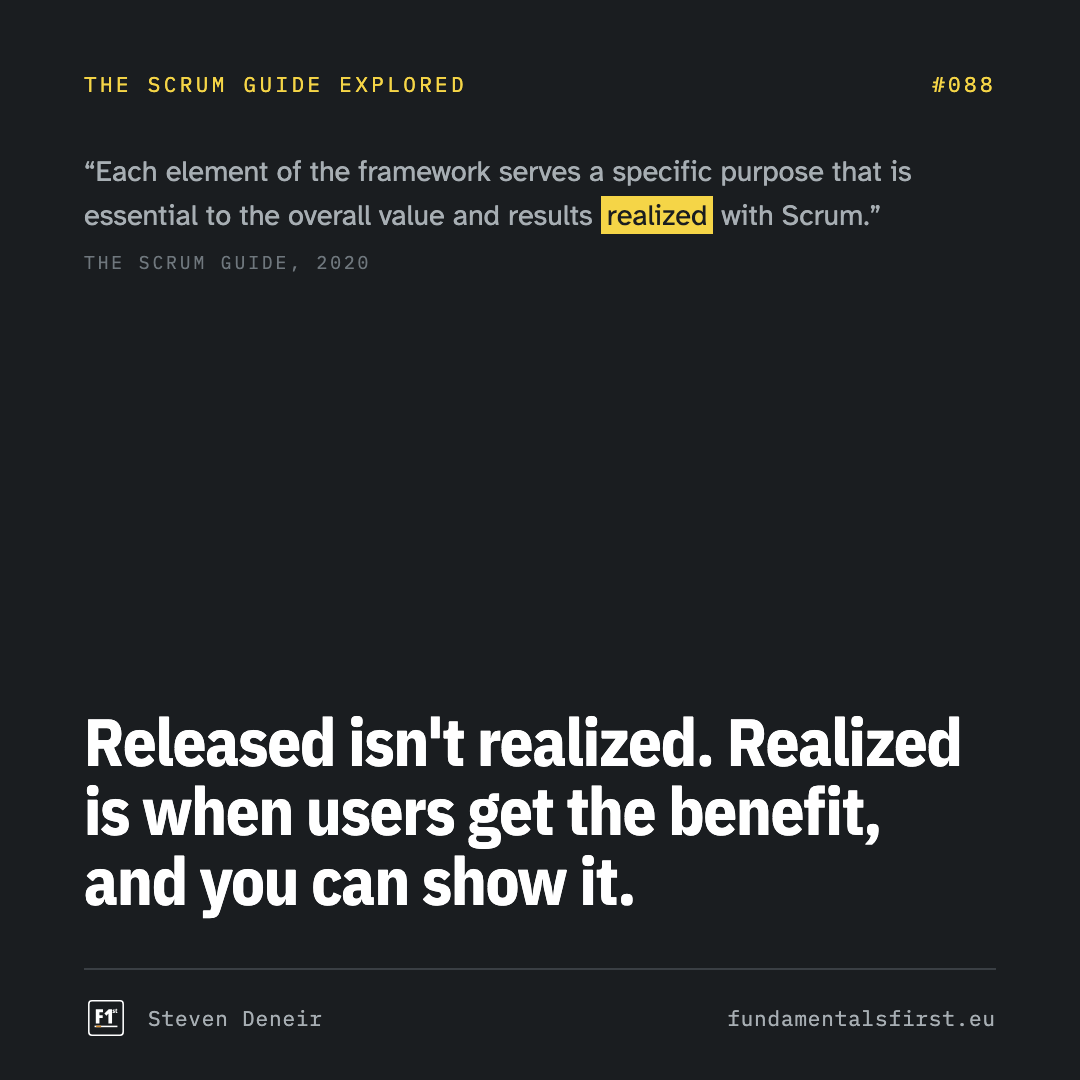
Most teams have a pretty good view on their next release date. Almost no team has a date to check whether users got the benefit.From the Scrum Guide: "Each element of the framework serves a specific purpose that is essential to the overall value and results realized with Scrum."The Cambridge Dictionary defines realize…
Most teams have a pretty good view on their next release date. Almost no team has a date to check whether users got the benefit.From the Scrum Guide: "Each element of the framework serves a specific purpose that is essential to the overall value and results realized with Scrum."The Cambridge Dictionary defines realize…
The Cambridge Dictionary defines realize as "to achieve things you hope for or plan for."
Hold that against how teams usually count. They plan an item, build it, release it and call it done. A release puts something in the hands of users, and that's where realizing value and results can start. Value is realized when the users get the outcome and the benefit you expected, and your team has the evidence to show it.
So in my classes and in coaching, I ask: how do you know the value of what you released was realized? It usually goes silent. The honest answer people give me is that it just isn't monitored. The team keeps producing, and nobody knows whether what it made gets used, let alone whether users get the benefit it was meant to bring.
And what you expect often doesn't happen. When Microsoft tested ideas in controlled experiments, less than a third moved the metric they were designed to improve (Kohavi and colleagues, 2013). The rest made no difference or made things worse. A team that never checks can't tell which of its releases landed. It plans the next ones on guesses.
Teams that do check get something back. DORA's 2023 Accelerate State of DevOps report found that teams with a strong user focus have 40% higher organizational performance. That focus includes using user feedback to decide what comes next, and judging a team's success by the value it brings users. It's survey data, so treat it as direction, and let your own releases show whether it holds for you.
In context
- Topic: Proyectos, PMO y Riesgos — Gestión de proyectos, oficinas de proyecto y riesgo del portafolio.
- Source: Scrum.org
- Published: 26/11/2026
Continue reading at the original source →
Excerpt published automatically by the site radar. The full text belongs to its publisher and is linked above.
Why it matters
Projects rarely fail on the day they are declared failed. They fail months earlier, in a meeting where somebody saw the problem coming and calculated it was not in their interest to say so. Everything else — the slipping schedule, the stretching budget — is the visible consequence of that silence.
What I look at first in a case like this is not the plan, it is how often it gets corrected. A project that replans every month with fresh data lands far closer than one that spends a year defending the baseline it signed when it knew least.
What usually goes wrong
What I see fail most is the absent sponsor. They sign the kick-off, appear in the photo, and do not come back until there is a problem. Without somebody with real authority clearing obstacles every fortnight, the project manager ends up negotiating as an equal with areas that do not report to them, and loses.
What to watch
- Who the sponsor is and how often they actually show up — not on the org chart, in the calendar.
- Whether the status report shows any red projects: an all-green portfolio is a portfolio without information.
- Which risks are identified, who owns each one, and when they were last reviewed.
How I read this entry
I would use it to review how the organisation estimates. If historical estimates were systematically out by half and nobody adjusted the method, no project will land well: you are planning with a ruler that measures short and blaming the team for not reaching the mark.
This entry is an excerpt from the original source, selected by the site radar. The commentary above is the site's own and does not belong to the cited publisher.
Comments
No comments yet. Yours can be the first.
Living through this in your own team?
Open the chat and tell me how you're handling it. I'm interested in comparing notes.


