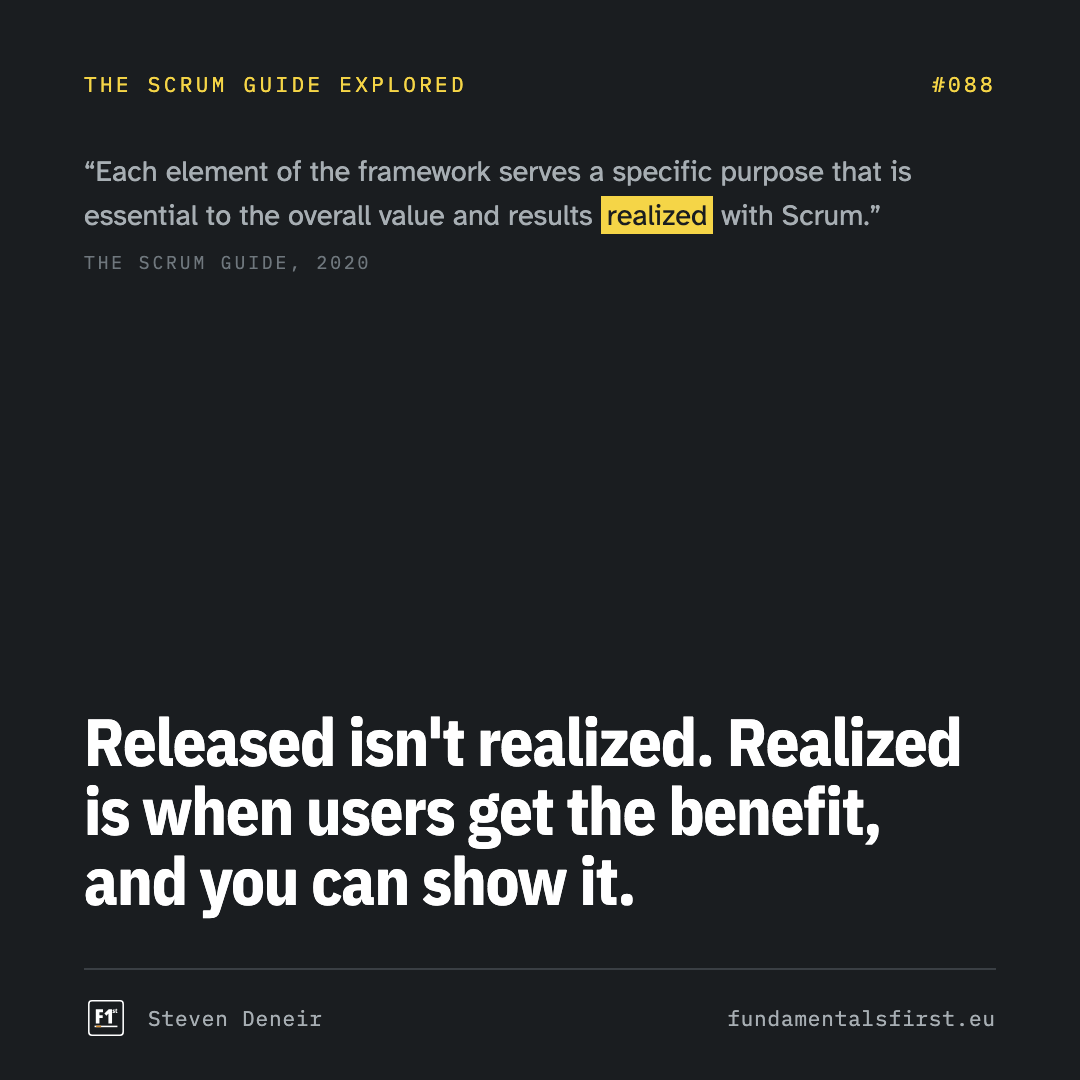
Most teams have a pretty good view on their next release date. Almost no team has a date to check whether users got the benefit.From the Scrum Guide: "Each element of the framework serves a specific purpose that is essential to the overall value and results realized with Scrum."The Cambridge Dictionary defines realize…
Most teams have a pretty good view on their next release date. Almost no team has a date to check whether users got the benefit.From the Scrum Guide: "Each element of the framework serves a specific purpose that is essential to the overall value and results realized with Scrum."The Cambridge Dictionary defines realize…
The Cambridge Dictionary defines realize as "to achieve things you hope for or plan for."
Hold that against how teams usually count. They plan an item, build it, release it and call it done. A release puts something in the hands of users, and that's where realizing value and results can start. Value is realized when the users get the outcome and the benefit you expected, and your team has the evidence to show it.
So in my classes and in coaching, I ask: how do you know the value of what you released was realized? It usually goes silent. The honest answer people give me is that it just isn't monitored. The team keeps producing, and nobody knows whether what it made gets used, let alone whether users get the benefit it was meant to bring.
And what you expect often doesn't happen. When Microsoft tested ideas in controlled experiments, less than a third moved the metric they were designed to improve (Kohavi and colleagues, 2013). The rest made no difference or made things worse. A team that never checks can't tell which of its releases landed. It plans the next ones on guesses.
Teams that do check get something back. DORA's 2023 Accelerate State of DevOps report found that teams with a strong user focus have 40% higher organizational performance. That focus includes using user feedback to decide what comes next, and judging a team's success by the value it brings users. It's survey data, so treat it as direction, and let your own releases show whether it holds for you.
In context
- Topic: Proyectos, PMO y Riesgos — Gestión de proyectos, oficinas de proyecto y riesgo del portafolio.
- Source: Scrum.org
- Published: 26/11/2026
Continue reading at the original source →
Excerpt published automatically by the site radar. The full text belongs to its publisher and is linked above.
Por que importa
Os projetos raramente fracassam no dia em que são declarados fracassados. Fracassam meses antes, numa reunião em que alguém viu o problema chegando e calculou que não lhe convinha dizer. Todo o resto — o cronograma que escorrega, o orçamento que estica — é a consequência visível desse silêncio.
O que eu olho primeiro num caso assim não é o plano, é a frequência com que ele é corrigido. Um projeto que replaneja todo mês com dados frescos chega muito mais perto que um que passa um ano defendendo a linha de base que assinou quando menos sabia.
O que costuma dar errado
O que mais vejo falhar é o patrocinador ausente. Assina o início, aparece na foto e depois só volta quando há problema. Sem alguém com poder real removendo obstáculos a cada quinze dias, o gerente de projetos acaba negociando de igual para igual com áreas que não lhe reportam, e perde.
O que observar
- Quem é o patrocinador e com que frequência real aparece — não no organograma, na agenda.
- Se o relatório de status mostra projetos em vermelho: um portfólio todo verde é um portfólio sem informação.
- Quais riscos estão identificados, quem é dono de cada um e quando foram revisados pela última vez.
Como leio esta publicação
Eu usaria isto para revisar como se estima na organização. Se as estimativas históricas erraram sistematicamente pela metade e ninguém ajustou o método, não há projeto que dê certo: está se planejando com uma régua que mede curto e culpando a equipe por não chegar.
A notícia original está publicada em outro idioma; o trecho é citado como o veículo o entrega e o comentário é escrito em português.
Comentários
Ainda não há comentários. O primeiro pode ser o seu.
Está vivendo isso na sua equipe?
Abra o chat e me conte como estão lidando com isso. Tenho interesse em comparar notas.