
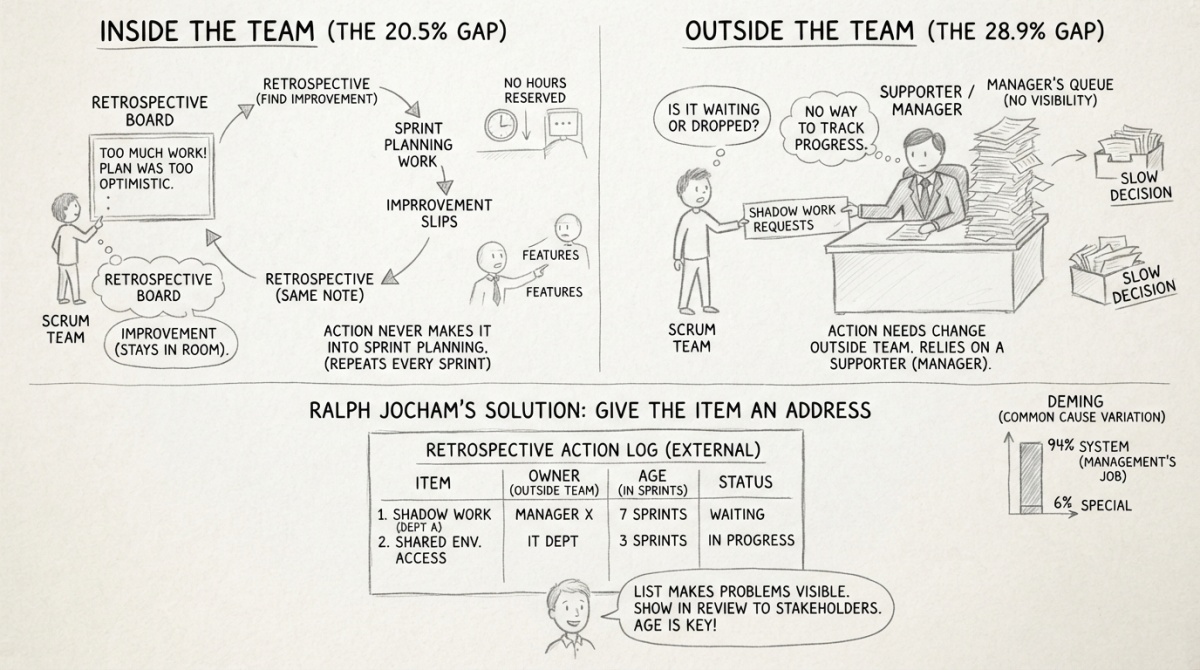
Image In the retrospectives I facilitate, the same three notes keep coming back. The team has too much work. The plan assumed everything would go right, so every Sprint starts maxed out and work rolls into the next one.The third note is about shadow work, the favours, urgent requests and quick fixes that arrive from ou…
Image In the retrospectives I facilitate, the same three notes keep coming back. The team has too much work. The plan assumed everything would go right, so every Sprint starts maxed out and work rolls into the next one.The third note is about shadow work, the favours, urgent requests and quick fixes that arrive from ou…
The Ceremony WorksEasy Agile's State of Team Alignment 2026 [1] surveyed 419 engineers, product managers and project managers. Of their teams, 61 percent rate their retrospectives as effective at finding meaningful improvements. Yet 69 percent carry out less than 60 percent of their retro actions before the next retrospective comes around.
When Easy Agile asked why actions stall, it found that in 28.9 percent of cases the action needed a change outside the team's control, and in 20.5 percent it never made it into Sprint Planning.
The report comes from a vendor of planning tools and keeps its method behind a sign-up form, so I read the figures as rough. Even so, the split between those two reasons matches what I see in client teams.
In my earlier piece on Kata, I argued that retrospectives lack a method for the adapt half of inspect and adapt. That argument was about actions a team owns, roughly the 20.5 percent. The 28.9 percent is a different problem, and a better method inside the team does little for it.
When the Action Stays in the RoomAn action that never reaches Sprint Planning dies inside the team. The Scrum Guide [2] already says the most useful improvements should be addressed quickly and "may even be added to the Sprint Backlog for the next Sprint." The Scrum Guide Expansion Pack [3], which I co-wrote, is firmer and says a team should not just talk about improvement, because Scrum "depends on meaningful, continuous improvement follow-through." Putting one improvement into the Sprint Backlog, with hours reserved for it, closes most of this gap.
In context
- Topic: Proyectos, PMO y Riesgos — Gestión de proyectos, oficinas de proyecto y riesgo del portafolio.
- Source: Scrum.org
- Published: 22/11/2026
Continue reading at the original source →
Excerpt published automatically by the site radar. The full text belongs to its publisher and is linked above.
Why it matters
Projects rarely fail on the day they are declared failed. They fail months earlier, in a meeting where somebody saw the problem coming and calculated it was not in their interest to say so. Everything else — the slipping schedule, the stretching budget — is the visible consequence of that silence.
What I look at first in a case like this is not the plan, it is how often it gets corrected. A project that replans every month with fresh data lands far closer than one that spends a year defending the baseline it signed when it knew least.
What usually goes wrong
The classic mistake is treating risk management as a deliverable of the planning phase. The matrix gets built, approved, filed. Nobody opens it again until closure, when it serves to document that the risk was foreseen — which is exactly the opposite of managing it.
What to watch
- The size of the first useful delivery: the further out it is, the more it resembles a bet.
- How it was estimated and how close the same organisation's previous estimates turned out to be.
- Who the sponsor is and how often they actually show up — not on the org chart, in the calendar.
How I read this entry
If this landed on my desk, the first thing I would ask for is not percentage complete: it is the list of pending decisions with a name and a date. A percentage can be dressed up; a decision stuck for three weeks with an identified owner cannot be argued with, and it explains the delay far better.
This entry is an excerpt from the original source, selected by the site radar. The commentary above is the site's own and does not belong to the cited publisher.
Comments
No comments yet. Yours can be the first.
Living through this in your own team?
Open the chat and tell me how you're handling it. I'm interested in comparing notes.


