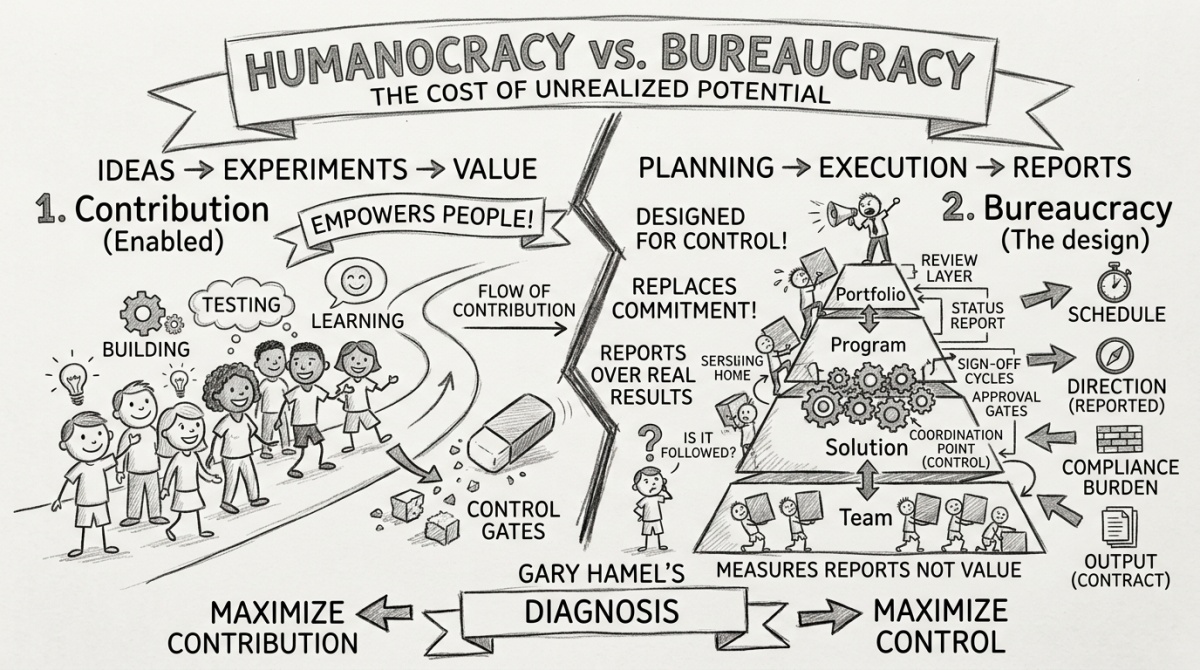
Image Gary Hamel spent decades asking why large organizations become rigid, slow, and hard to work inside. His diagnosis is simple: bureaucracy is not a symptom of poor management. It is a design, and its purpose is control, not the creation of value.
Image Gary Hamel spent decades asking why large organizations become rigid, slow, and hard to work inside. His diagnosis is simple: bureaucracy is not a symptom of poor management. It is a design, and its purpose is control, not the creation of value.
The teams that struggle most are rarely short of process. They have Release Train Engineers, quarterly PI Planning, Portfolio SAFe layers, and Agile coaches in numbers that would surprise most startups, and they are usually less able to respond to change than they were before any of this arrived.
What Hamel FoundHamel and Michele Zanini spent years measuring what bureaucracy costs before publishing Humanocracy in 2020 [1]. In the United States, management and admin jobs doubled between 1983 and the time of their research, while other roles grew by less than 40 percent. By 2014, there was one manager or admin for every 4.7 workers, around 18.5 million people whose core job is oversight, review, and sign-off. Their wages alone ran to about $1.4 trillion, and that is before counting the output they would produce if redirected to value-creating work. Hamel and Zanini put the total annual cost of bureaucracy at around $3 trillion in the US, and around $9 trillion across OECD countries [2].
The problem is not that people stop working. It is that work gets aimed at the wrong thing. Every approval layer, every sign-off cycle, every status report exists because someone decided that knowing what is going on matters more than letting the people closest to the work make the call. Hamel names what this builds: an org that runs on control, not contribution. His alternative, Humanocracy, starts from the opposite goal: maximize contribution, not control.
In context
- Topic: Proyectos, PMO y Riesgos — Gestión de proyectos, oficinas de proyecto y riesgo del portafolio.
- Source: Scrum.org
- Published: 11/10/2026
Continue reading at the original source →
Excerpt published automatically by the site radar. The full text belongs to its publisher and is linked above.
Por qué importa
En gestión de proyectos casi todo lo que se discute como problema técnico es en realidad un problema de expectativas mal negociadas al principio. Alcance, plazo y costo se pactaron en un momento en que nadie tenía la información suficiente, y después nadie quiso reabrir la conversación.
Mi filtro es la calidad del reporte de estado. Si todos los proyectos están en verde, el sistema de información no sirve: en cualquier portafolio real hay iniciativas en problemas, y una organización sana las muestra a tiempo en vez de descubrirlas en el comité de cierre.
Lo que suele salir mal
Lo que más veo fallar es el patrocinador ausente. Firma el inicio, aparece en la foto y después no vuelve hasta que hay un problema. Sin alguien con poder real que despeje obstáculos cada quince días, el jefe de proyecto termina negociando de igual a igual con áreas que no le reportan, y pierde.
Qué mirar
- Qué riesgos están identificados, quién es dueño de cada uno y cuándo se revisaron por última vez.
- El tamaño de la primera entrega útil: mientras más lejos esté, más se parece a una apuesta.
- Cómo se estimó y qué tan cerca estuvieron las estimaciones anteriores de la misma organización.
Cómo leo esta entrada
Si esto llegara a mi mesa, lo primero que pediría no es el avance porcentual: es la lista de decisiones pendientes con nombre y fecha. El porcentaje se puede maquillar; una decisión trabada hace tres semanas con un responsable identificado no se puede discutir, y explica el atraso mucho mejor.
La noticia original está publicada en otro idioma; acá se cita el extracto tal como lo entrega el medio y el comentario se escribe en español.
Comentarios
Todavía no hay comentarios. El primero puede ser el tuyo.
¿Lo estás viviendo en tu equipo?
Abrí el chat y contame cómo lo están manejando. Me interesa comparar notas.